
A practical guide to DIY websites, semi-custom design, custom projects, and the ongoing expenses that are easy to overlook.
One of the first questions therapists ask when planning a new website is also one of the hardest to answer simply: How much will it cost?
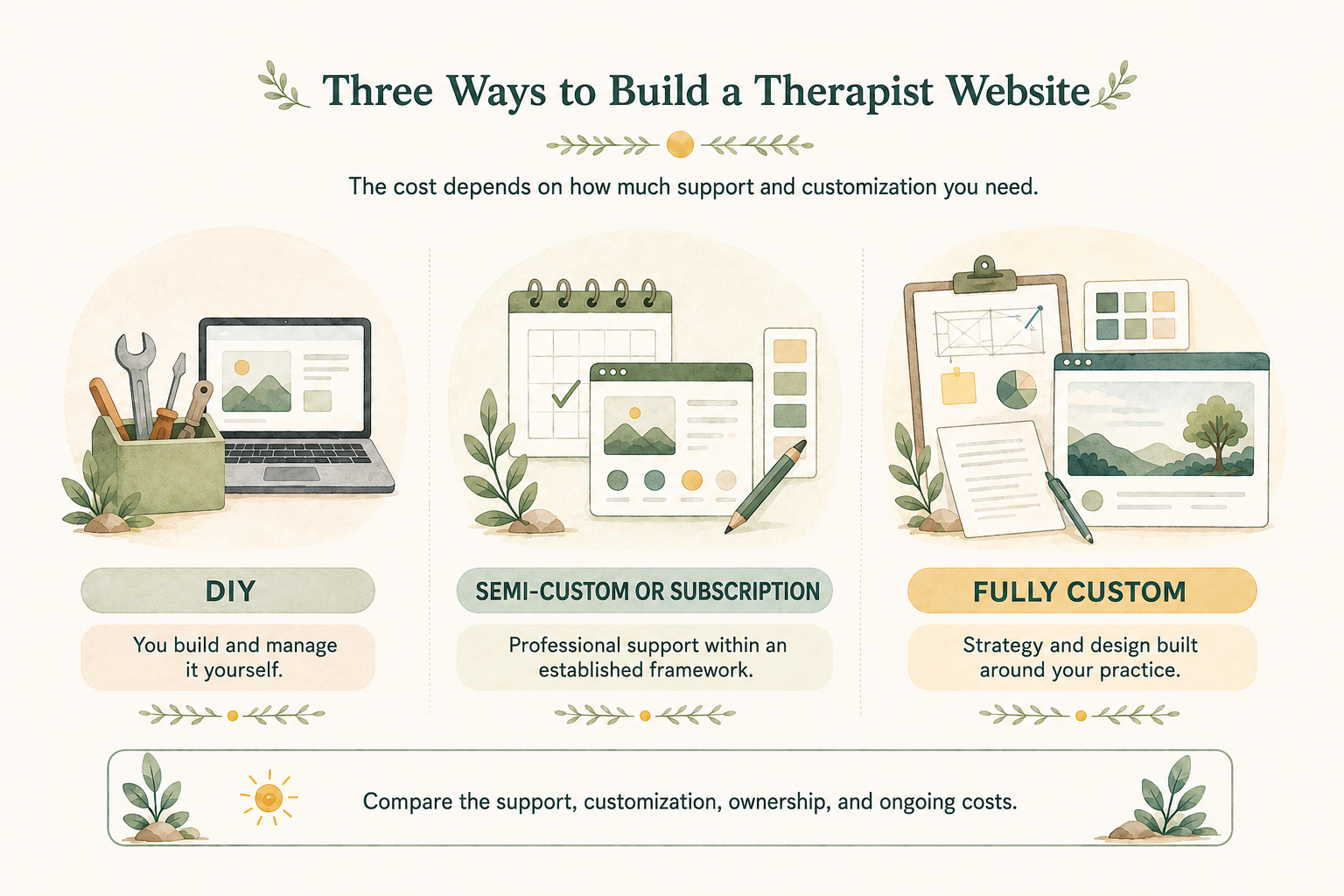
In 2026, a therapist website might cost a few hundred dollars per year, a few hundred dollars per month, several thousand dollars as a one-time project, or considerably more. Those options may all be described as “professional websites,” but they do not include the same level of strategy, customization, writing, SEO, support, or ownership.
The most useful question is not only, “How much does a therapist website cost?” It is also, “What am I actually receiving for that investment, and is it right for this stage of my practice?”
This guide breaks down the most common pricing models, the expenses that are often left out of the initial quote, and how to decide where your money will make the biggest difference.
The short answer: What does a therapist website cost in 2026?
A therapist website can generally fall into one of these broad ranges:
- DIY website: approximately $200 to $700 per year, plus your time
- Basic subscription or template-based service: approximately $75 to $350 per month
- Professionally customized template or semi-custom website: approximately $2,000 to $6,000 over the initial agreement or project period
- Fully custom website for a solo practice: approximately $4,000 to $10,000 or more
- Custom group practice or multi-location website: approximately $6,000 to $15,000 or more
These are broad planning ranges, not universal rules. The final therapist website cost depends on the number of pages, the amount of original writing, the complexity of the practice, the level of design, the SEO strategy, and what support is included before and after launch.
A lower-cost website is not automatically a poor choice. A higher-cost website is not automatically a strategic one. The right investment depends on what your practice needs the website to accomplish.
Why therapist website prices vary so much
Website pricing can feel confusing because two proposals may use similar language while describing completely different services.
One provider may start with a prebuilt template and ask you to supply all of the content. Another may spend weeks clarifying your audience, organizing services, writing original copy, planning SEO, developing a visual identity, and creating every page around your practice.
Both may call the finished product a five-page therapist website. The page count is the same, but the work behind those pages is not.
The price is usually shaped by five major factors:
What technical support continues after launch
How original the design will be
How much strategy and planning are included
Who writes and organizes the content
How much SEO work is built into the project
Option 1: Building a therapist website yourself
A DIY website is usually the least expensive option in dollars. You pay for a platform such as Squarespace, Wix, or WordPress hosting, purchase a domain, select a template, and build the pages yourself.
The basic technology may cost only a few hundred dollars per year. That makes DIY appealing to therapists who are opening a practice, have very limited funds, or need a simple online presence quickly.
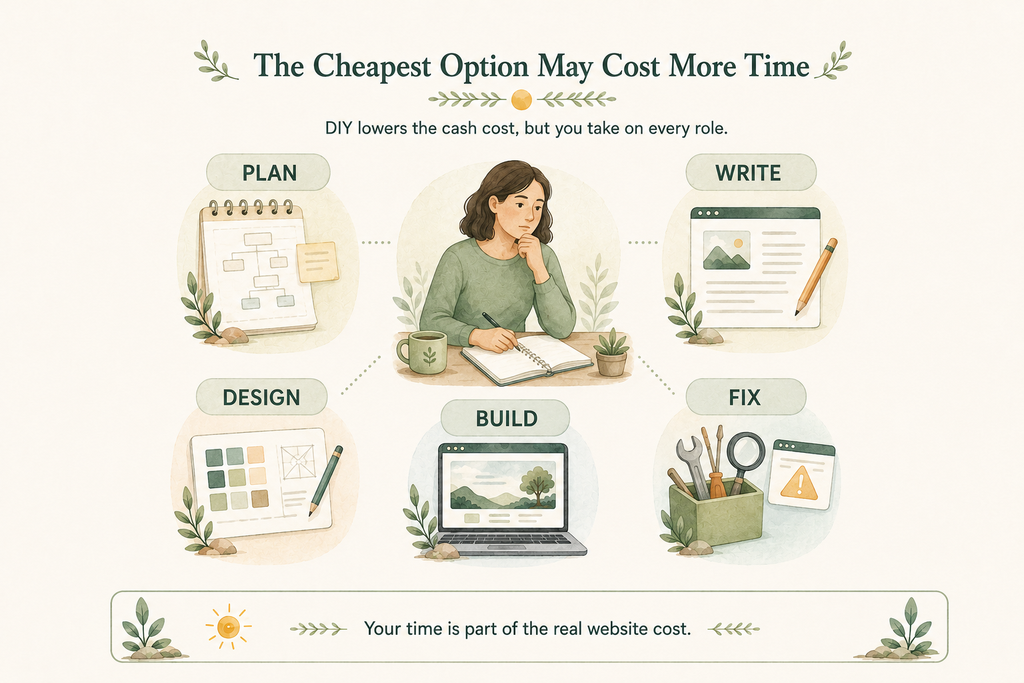
The less visible cost is your time.
A website that appears simple may still require you to:
- Choose and configure the platform
- Plan the pages and navigation
- Write all of the content
- Select and prepare images
- Adjust the design for phones and tablets
- Connect forms, scheduling, and analytics
- Learn basic SEO
- Troubleshoot anything that does not work
For someone who enjoys technology and design, this may be manageable. For someone who finds website work draining or who has a full caseload, the time commitment can become much more expensive than expected.
When a DIY therapist website may be enough
A DIY website can be a reasonable temporary solution when you are starting very small, offer one primary service, and mainly need a credible place to send referrals.
It becomes less suitable when you need the website to consistently bring in new people through search, represent a growing team, support several specialties, or differentiate your practice in a competitive market.
Option 2: A subscription-based or template website service
Subscription website services spread the cost over time. Instead of paying several thousand dollars upfront, you pay a monthly fee that may include the website, hosting, support, and selected marketing tools.
In 2026, many therapy-focused subscription services fall somewhere between about $75 and $350 per month. Some charge an additional setup fee. Others require an annual or multi-year agreement.
This can be easier to budget for, but it is important to calculate the full cost over the length of the agreement. A $200 monthly website costs $2,400 per year and $4,800 over two years.
Ask what happens if you cancel. Some services let you take the website with you. Others are rented systems, meaning the website may disappear or need to be rebuilt when the subscription ends.
What to check before choosing a subscription website
Before comparing monthly prices, find out:
- How many pages are included
- Whether the content is original or drawn from a shared library
- How much design customization is available
- Whether SEO means basic technical setup or deeper keyword strategy
- Whether hosting and maintenance are included
- How many revisions or updates you receive
- Whether you own the website and can move it elsewhere
- How long the agreement lasts
- What happens to the site when you cancel
A low monthly payment can be a good fit, but only when the service matches what you actually need.
Option 3: A semi-custom therapist website
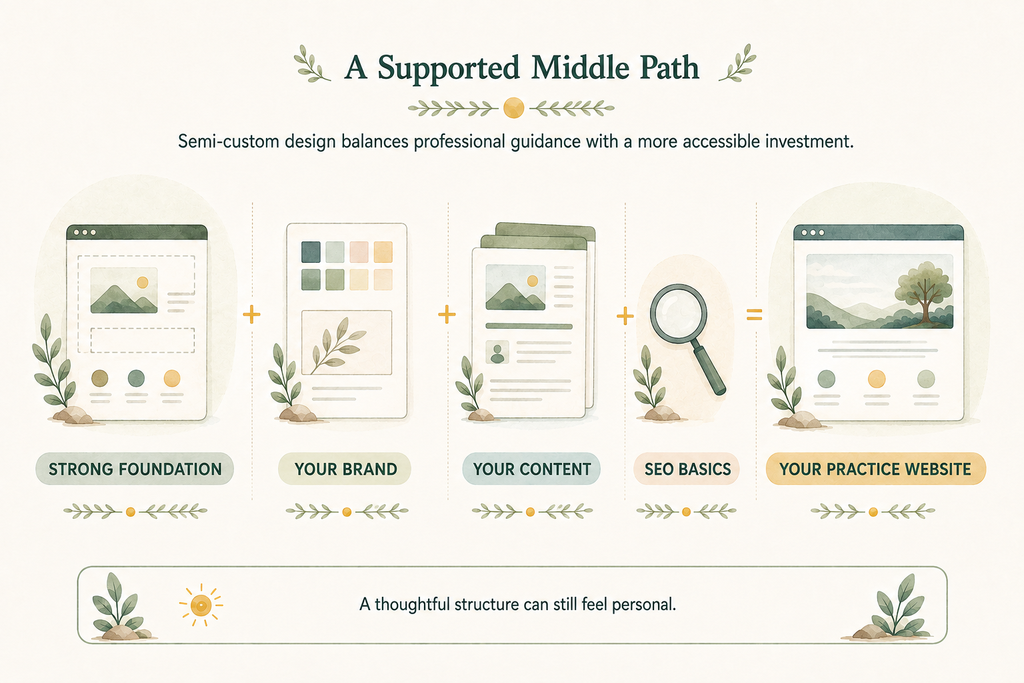
A semi-custom website sits between a basic template and a fully custom project.
The designer begins with a thoughtfully designed framework, then adapts the colors, fonts, images, content, page structure, and other details to the practice. Because the underlying design system already exists, the project requires less time than creating every element from the ground up.
For therapists working with a limited budget, this is often the option I recommend.
A well-designed semi-custom website can provide:
- A professional and cohesive visual presence
- Structure created specifically for a therapy practice
- Guidance from someone who understands therapist websites
- Separate pages for core services
- A clear path for prospective clients
- Foundational SEO
- A more manageable monthly or project investment
The important distinction is that semi-custom should still feel intentional. It should not simply replace a name and photograph on a generic template. The content and key choices should reflect the actual practice.
Who is a semi-custom website best for?
Semi-custom design is often a strong fit for a solo therapist or small practice that wants professional help but does not yet need a completely original visual system or a large, complex website.
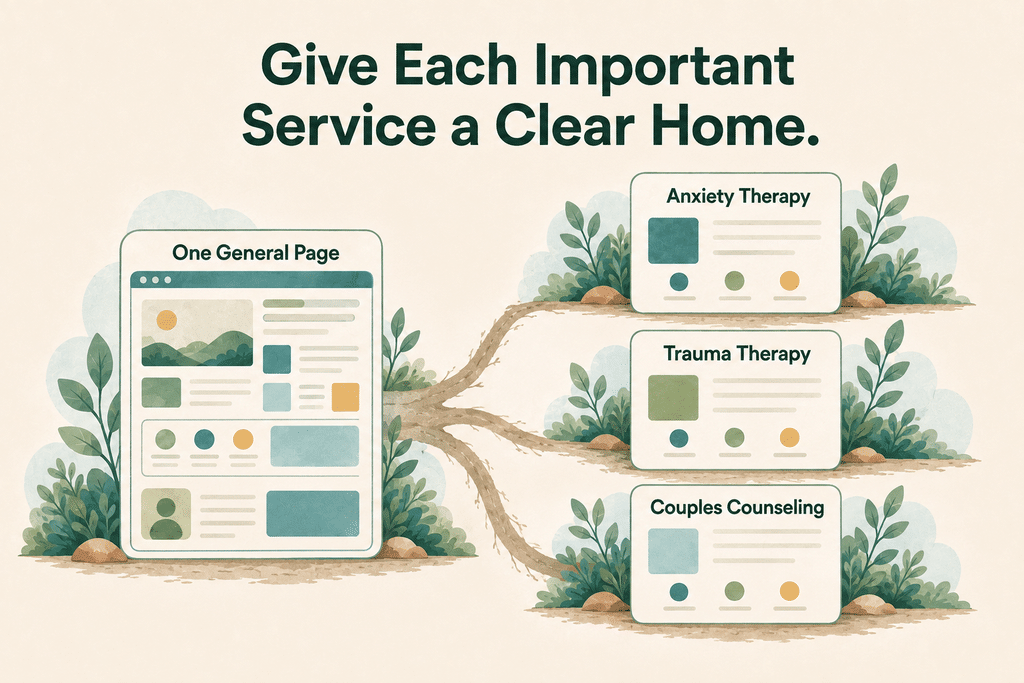
It can also be helpful for someone who wants predictable costs, clear boundaries, and guidance without taking on the entire project alone.ll variation needs its own page. It means that the services you actively want people to find should generally have enough space to stand on their own.
Option 4: A fully custom therapist website
A fully custom website is created around the practice rather than adapted from an existing design.
A custom project may include strategy, page planning, original copywriting, branding or logo development, customized visual design, foundational SEO, mobile optimization, forms, scheduling connections, analytics, and launch support.
For solo therapists, fully custom website projects often begin around $4,000 and can reach $10,000 or more. A group practice, multi-location clinic, training program, or practice with many services may require a larger investment.
The price increases because the project involves more than assembling pages. It requires decisions about positioning, visitor pathways, search strategy, content hierarchy, and how the website should support the practice over time.
When is a custom therapist website worth the investment?
A custom website may make sense when:
- Your current website no longer reflects the quality of your work
- You are established and want to attract more right-fit clients
- You offer several important services that need individual pages
- You are building or growing a group practice
- Your market is highly competitive
- You need a distinct brand rather than a familiar template look
- Your website is expected to play a meaningful role in referrals and growth
Custom design is not necessary simply because it is the most expensive option. It becomes worthwhile when the strategy, writing, organization, and visual identity solve real problems for the practice.
What affects the cost of a therapist website?
The initial price usually reflects the scope of the work. These are the factors most likely to change the quote.
The number and type of pages
A five-page solo website costs less than a 25-page group practice website, but page count is not the only consideration.
A new service page that requires original research, keyword planning, and copywriting takes more work than a simple Contact page. Individual clinician bios may follow a repeatable format, while a psychological testing page may require extensive explanation and careful organization.
Copywriting
Some website designers expect you to provide polished final copy. Others include editing, guided content development, or complete copywriting.
This difference can significantly affect both the price and the final result. Clear writing is especially important for therapist websites because visitors need to understand the services, feel a sense of connection, and know what to do next.
Ask whether the quote includes writing, editing, keyword research, or simply placing the content you provide.
Branding and visual identity
A project may use your existing logo and brand colors, include a simple visual refresh, or develop an entirely new identity.
Logo design, color strategy, typography, custom illustrations, and original photography all add time and cost. They can also make the website feel more cohesive and distinct when those elements are genuinely needed.
SEO strategy
“SEO included” can mean many different things.
At a basic level, it may include page titles, meta descriptions, mobile responsiveness, image alt text, and a clean heading structure. A more complete strategy may include keyword research, separate service pages, location planning, internal linking, content recommendations, technical review, and analytics setup.
If search visibility is important to your practice, ask what specific work is included. A website cannot target every service and location effectively if those needs were never considered when the pages were planned.
Practice size and complexity
Group practices usually need more pages, more navigation planning, individual clinician profiles, and a clearer intake pathway. Multiple locations, different clinician availability, evaluations, training programs, or several types of services can add complexity.
The cost is not higher simply because the organization is larger. It is higher because the website has more information and relationships to organize.
Special features and integrations
Most therapist websites do not need complicated custom software. Still, scheduling systems, directories, searchable team pages, protected resources, courses, memberships, multilingual content, or advanced forms can increase the scope.
Before paying for a custom feature, make sure it will meaningfully improve the client experience or the operation of the practice.e same page to understand what happens next.
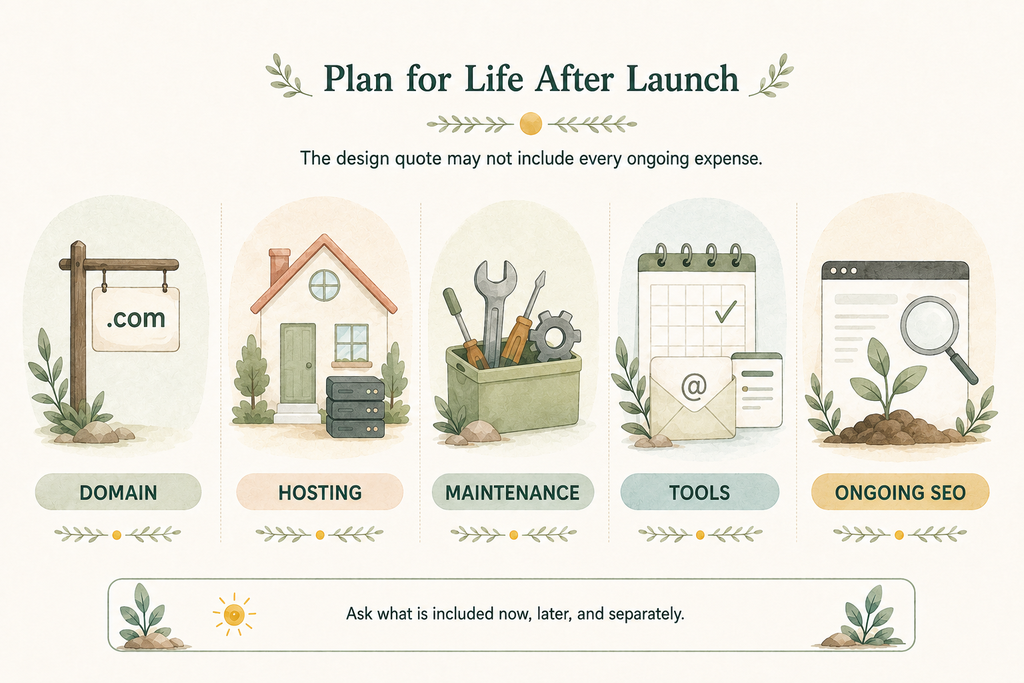
Website costs that are often overlooked
The design quote is not always the total cost of owning and operating the website. Ask about these expenses before comparing proposals.
Domain registration
Your domain name is usually a small annual expense, often around $15 to $30. It should be registered in your name or in an account your practice controls.
Website hosting
Hosting is the service that keeps the website available online. Basic hosting may cost only a few dollars per month, while managed WordPress hosting and more hands-on support cost more.
The least expensive hosting is not always the best value. Reliability, backups, security, speed, and access to knowledgeable support matter when the website is an important part of your practice.
Maintenance and website care
Hosting and maintenance are not the same thing.
Hosting gives the website a place to live. Maintenance may include WordPress and plugin updates, backups, security monitoring, troubleshooting, broken-link checks, and small content changes.
A custom website project may include support during launch without including ongoing maintenance. Confirm who will care for the site after the initial support period ends.
Professional email and privacy-conscious forms
A branded email address, secure form service, scheduling platform, or electronic health record system may have its own monthly charge.
A standard website contact form should collect only the information needed for an initial inquiry. If you plan to collect sensitive health information, discuss the technical and privacy requirements with qualified professionals rather than assuming a standard website form is sufficient.
Ongoing SEO and content
Foundational SEO helps a website launch with a sound structure. It does not guarantee that a new site will immediately rank for competitive searches.
Ongoing SEO may include new service or location pages, educational content, technical improvements, performance analysis, and updates based on search data. This work is usually priced separately from the website build.
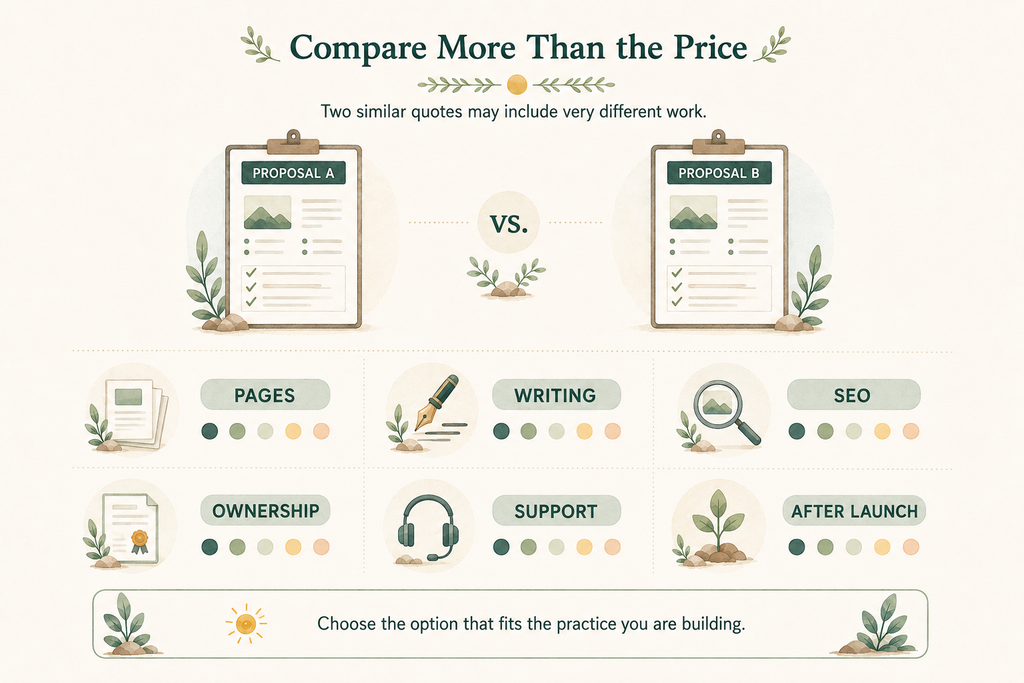
How to compare therapist website proposals
A clear proposal should make it possible to compare more than the total price.
Ask each provider:
- How many pages are included?
- Who plans the website structure?
- Who writes or edits the content?
- What level of customization is included?
- What SEO work will be completed?
- Are hosting and maintenance included or separate?
- Who owns the domain, content, and website?
- Can the website be moved to another provider?
- How many rounds of feedback are included?
- What support is available after launch?
A proposal that costs less may still be the right choice. You simply want to know which responsibilities remain yours and which results the project is designed to support.
Red flags to watch for
Price alone does not reveal whether a website service is reliable. Pay attention to the terms and the clarity of the process.
Be cautious when:
- The provider promises guaranteed Google rankings
- “Custom” appears to mean changing only colors and photos
- The content will be reused across many therapist websites
- You cannot tell who owns the domain or the finished website
- The agreement makes it difficult to leave or move the site
- SEO is advertised without any explanation of what is included
- The quote omits hosting, maintenance, or renewal costs
- The process does not include time to understand the practice
A trustworthy provider should be able to explain both what is included and what is not., while service pages explain how the practice approaches each area of care.
How much should a new therapist spend on a website?
A therapist opening a new private practice does not always need a large custom project immediately.
If the budget is limited, I generally recommend a semi-custom therapist website. It provides professional guidance and a structure created for a therapy practice without requiring the full investment of custom design.
The priority is to build a clear and credible foundation: a homepage, About page, separate pages for important services, and a Contact page. The website can grow as the practice becomes more established.
A beautiful five-page website with clear content and a thoughtful structure is more valuable than a large website filled with thin, repetitive pages.
Is a therapist website an expense or an investment?
A website is both a business expense and a long-term practice asset.
It should not be evaluated only by whether it looks polished. A useful therapist website can help prospective clients find the practice, understand the services, feel more comfortable reaching out, and arrive at the intake process with clearer expectations.
That does not mean every therapist should purchase the most expensive website possible. The investment should be proportionate to the role the website will play.
If most clients come through established professional referrals and the website mainly confirms credibility, a simpler site may be enough. If the practice needs to consistently bring in new people through search, fill several clinicians, launch new services, or enter a competitive market, strategy and SEO become much more important.
Questions to ask before deciding what to spend
Before choosing a website option, consider:
- What does the website need to accomplish during the next two or three years?
- How many services genuinely need their own pages?
- Will I write the content, or do I need help?
- Is search visibility important to the growth plan?
- Do I need a distinct brand or simply a polished, credible presence?
- How much time can I realistically devote to building and maintaining the site?
- Am I comfortable with a recurring subscription?
- Will I own the website if I change providers?
These answers will usually tell you more than an arbitrary rule about what a therapist “should” spend.
Therapist website cost FAQ
Can I build a therapist website for free?
You may be able to begin with a free platform or trial, but a professional practice will generally need a paid domain and website plan. Free options often include platform branding, limited features, or restrictions that make them less suitable for an established business.
How much does a five-page therapist website cost?
A five-page website may cost a few hundred dollars if you build it yourself, a recurring monthly fee through a subscription or semi-custom service, or several thousand dollars for professional custom design. The price depends heavily on whether strategy, copywriting, branding, and SEO are included.
Is semi-custom the same as a template website?
A semi-custom website begins with an established design framework, but it should be thoughtfully adapted to the practice. The distinction is the degree of professional guidance, content strategy, customization, and attention to the client journey.
Does website design include SEO?
Sometimes, but the term can refer to anything from basic page settings to a full keyword and content strategy. Ask for a specific list of the SEO work included in the project.
Do I need to pay for website maintenance?
A website needs ongoing technical care even when the content rarely changes. You can handle updates yourself or pay for a maintenance plan. Hosting alone does not necessarily include software updates, troubleshooting, security checks, or content changes.
Should I pay monthly or choose a one-time website project?
Neither model is automatically better. Monthly pricing can make professional support more accessible and may include ongoing services. A one-time project may provide greater ownership and fewer long-term payments. Compare the total cost, contract length, support, and what happens if you leave.
If you’re weighing your options, these guides can help:
- Squarespace vs WordPress for Therapists
- What Pages Every Therapist Website Needs
- What Is Website Hosting? A Beginner’s Guide for Therapists
Choose the website that fits the practice you are building
There is no single correct therapist website cost.
The right choice may be a simple DIY site, a supported semi-custom website, or a fully custom project. What matters is that you understand what you are paying for and choose a website that can support the next stage of your practice without creating unnecessary financial or technical stress.
For therapists who want professional guidance at a more accessible price, a semi-custom website can provide a strong middle path. For established solo therapists and growing practices with more complex needs, custom design can create a deeper strategic foundation.
Strong Roots Web Design offers both semi-custom and fully custom therapist websites, so we can help you choose an approach based on your goals, your budget, and the kind of practice you are working to build.