
If you’re looking into a new website for your therapy practice, you may have noticed that the prices are all over the place. TherapySites offers websites for a monthly fee. Brighter Vision does too. Then you speak with a custom web designer and hear a price in the thousands.
It’s reasonable to wonder what you’re actually paying more for. Is a custom website really that different? And, more importantly, would that difference matter for your practice?
I design websites for therapists, so I do have a perspective here. But I don’t think every therapist needs a custom website. Some practices are much better served by starting with something simpler. The trick is figuring out which kind of website will support the work you’re doing now, without paying for things you don’t need.
First, what are you actually choosing between?
TherapySites and Brighter Vision offer professionally assembled websites based on existing designs. You choose a starting point, personalize it for your practice, and pay an ongoing subscription for the website and related services. The appeal is pretty straightforward: there’s a system in place, someone helps you get set up, and you don’t have to become a website expert.
With a fully custom website, the process starts somewhere else. Before deciding how a page should look, we spend time figuring out who needs to find you, what they need to understand, and what makes your work distinctive. The writing, organization, and design grow out of those conversations.
That may sound like a subtle distinction, but it’s an important one. One approach starts with a structure and adapts it to your practice. The other starts with your practice and creates the structure around it.
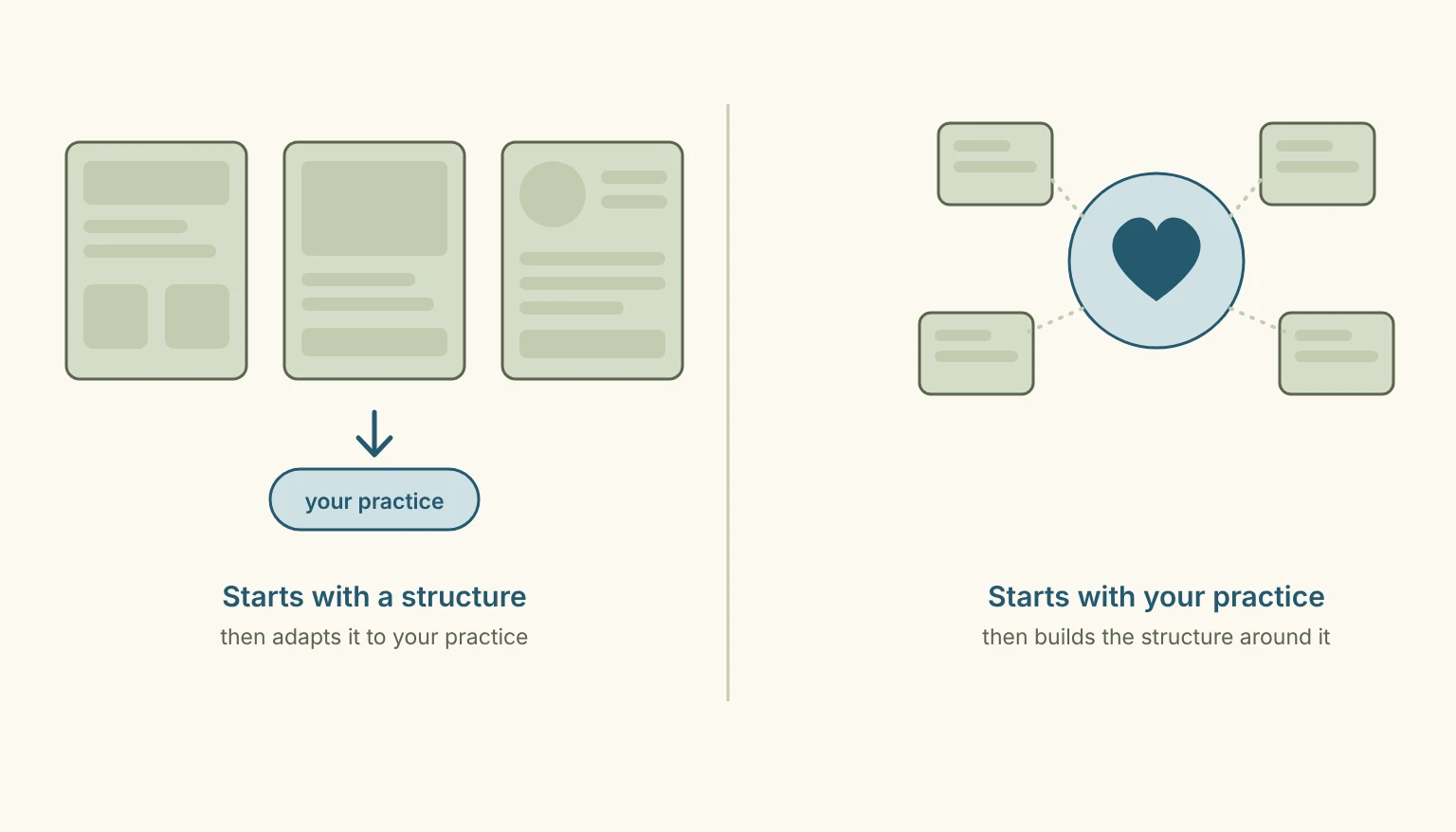
Neither approach is automatically better. It depends on how much thinking and tailoring your website needs.
What TherapySites and Brighter Vision do well
I think it’s easy for custom designers to be dismissive of template-based services, and that’s not particularly fair. These companies fill a real need.
If you’re opening a practice, managing a full caseload, or simply don’t want to spend your evenings sorting out website hosting, a service that handles the technical pieces can be a huge relief. Both companies offer professional design assistance, hosting, and support. TherapySites offers different levels of search and marketing services, while Brighter Vision includes tools such as a library of prewritten content.
And a template does not have to look bad or feel impersonal. A thoughtfully chosen design, good photographs, and writing that actually sounds like you can go a long way.
The limitation is less about appearance than flexibility. If your practice has several specialties, a growing team, or services that need a little more explanation, you may find yourself trying to fit something complicated into a structure that wasn’t planned with your specific practice in mind.
And who will you actually be working with?
There’s one difference I think matters just as much as the design, and it doesn’t always show up on a pricing page: the experience of working with the people behind the website.
TherapySites and Brighter Vision are larger companies, with larger teams and systems. That has its advantages. But it can also mean emailing one person during the design process, another when you need an update, and someone new the next time you have a question. If you have to keep explaining your practice or repeating a conversation you’ve already had, it can get frustrating. Especially when you’re trying to run a practice, not manage a website project.
When you work with Strong Roots, you’re working with me and a small team who really get to know you. We remember that you’re away at a conference this week. We remember what you’re excited about adding to your practice and what you’ve been worried isn’t coming across on your website. You don’t have to start from the beginning every time you reach out.
That personal relationship is a big part of what I want Strong Roots to offer. We’re not just trying to finish a website and move on to the next one. We care about the people behind the practices we work with, and we’re genuinely invested in helping those practices grow.
What you’re paying for with custom design
A custom website isn’t just a more expensive version of a template. At least, it shouldn’t be.
The extra work should go into understanding the people you’re trying to reach, deciding what belongs on each page, writing content that feels human and clear, and building a website that makes those pieces work together.
For example, imagine that you’re a psychologist who offers both therapy and psychological evaluations. Those are two very different reasons someone might visit your website. A person looking for an evaluation may want to know about the process, reports, referrals, and timelines. Someone seeking therapy is probably asking a different set of questions. Good website planning gives each person a clear path without making either one hunt for information.
I’ve seen how easily an important service can get lost. I once spent twenty minutes looking through a therapist’s website before finding out that she ran a support group for neurodivergent moms. It was a wonderfully specific offering, and exactly the sort of thing someone might be searching for. But it was so tucked away that a visitor could easily miss it.
A different color palette wouldn’t have fixed that. Making the group easier to find would.
That’s what I mean by strategy. It’s not a complicated marketing exercise. It’s the practical work of helping people quickly understand what you offer and whether you’re the right person to help.
There’s also a middle ground: semi-custom websites
You don’t necessarily have to choose between an inexpensive subscription and a fully custom project.
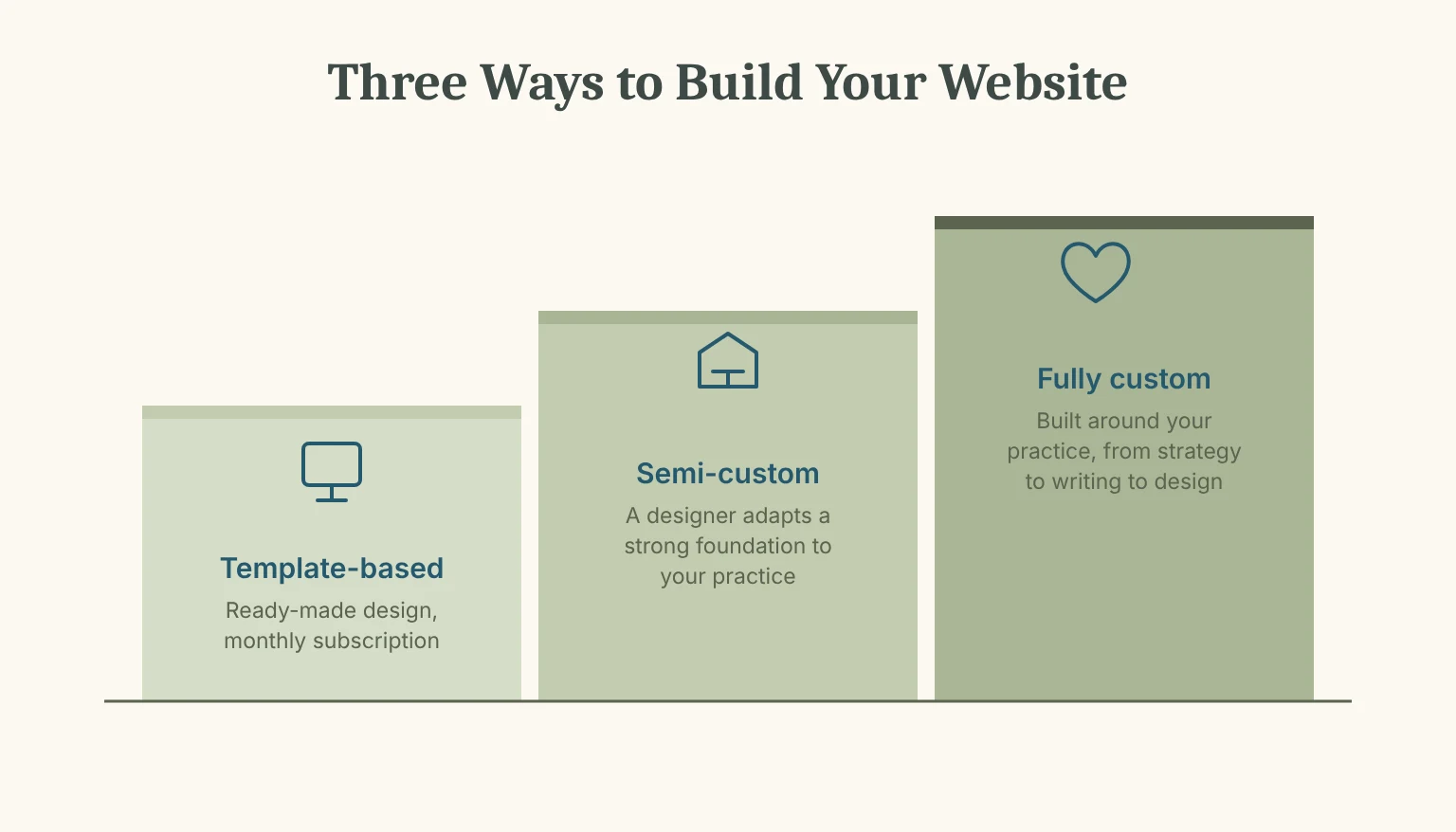
A semi-custom website begins with a carefully designed foundation, but a designer adapts it to your practice, your services, and your visual style. It gives you more individual attention and flexibility than a basic template service, without the investment involved in designing every element from scratch.
We offer semi-custom websites at Strong Roots for exactly this reason. They can be a lovely fit for a solo practitioner who wants a thoughtful, professional site and some real guidance, but doesn’t need an extensive custom design process.
So how do the costs compare?
Here’s a snapshot of the advertised starting points as of November 8, 2026. These aren’t identical packages, and prices and promotions can change, so please check the current details before making a decision.
- TherapySites: Its Core plan starts at $69 per month, with a listed $199 one-time website design fee. Higher monthly tiers add SEO and other marketing services. Secure email and forms are advertised as an add-on starting at $15 per month.
- Brighter Vision: Its Start plan is advertised at $99 per month, with a $100 setup fee. Flourish is listed at $349 per month and includes additional tools such as secure forms. Its public pages currently show different prices for the Grow tier, so I’d ask for a written quote and make sure you understand which features and billing terms it includes.
- Strong Roots semi-custom: Plans start at $195 per month for up to five pages, plus a $500 one-time build fee, with a 24-month commitment. You write your content using our guided template; hosting, maintenance, and support are included.
- Strong Roots fully custom: Our custom website projects start at $6,000, with the scope shaped around the practice. Strategy, original content development, and custom design are part of that process. Ongoing hosting and care are separate considerations.
When you compare prices, look at the total cost over the period you expect to use the website, not just the first payment. And look at what’s included: original writing, editing help, technical support, search optimization, secure forms, and what happens if you leave.
If you’d like a broader breakdown of website budgets, I’ve also written a guide to what a therapist website costs in 2026.
Five questions I’d ask before signing with anyone
These are the questions I’d want answered whether I were hiring a subscription service, an independent designer, or my own team.
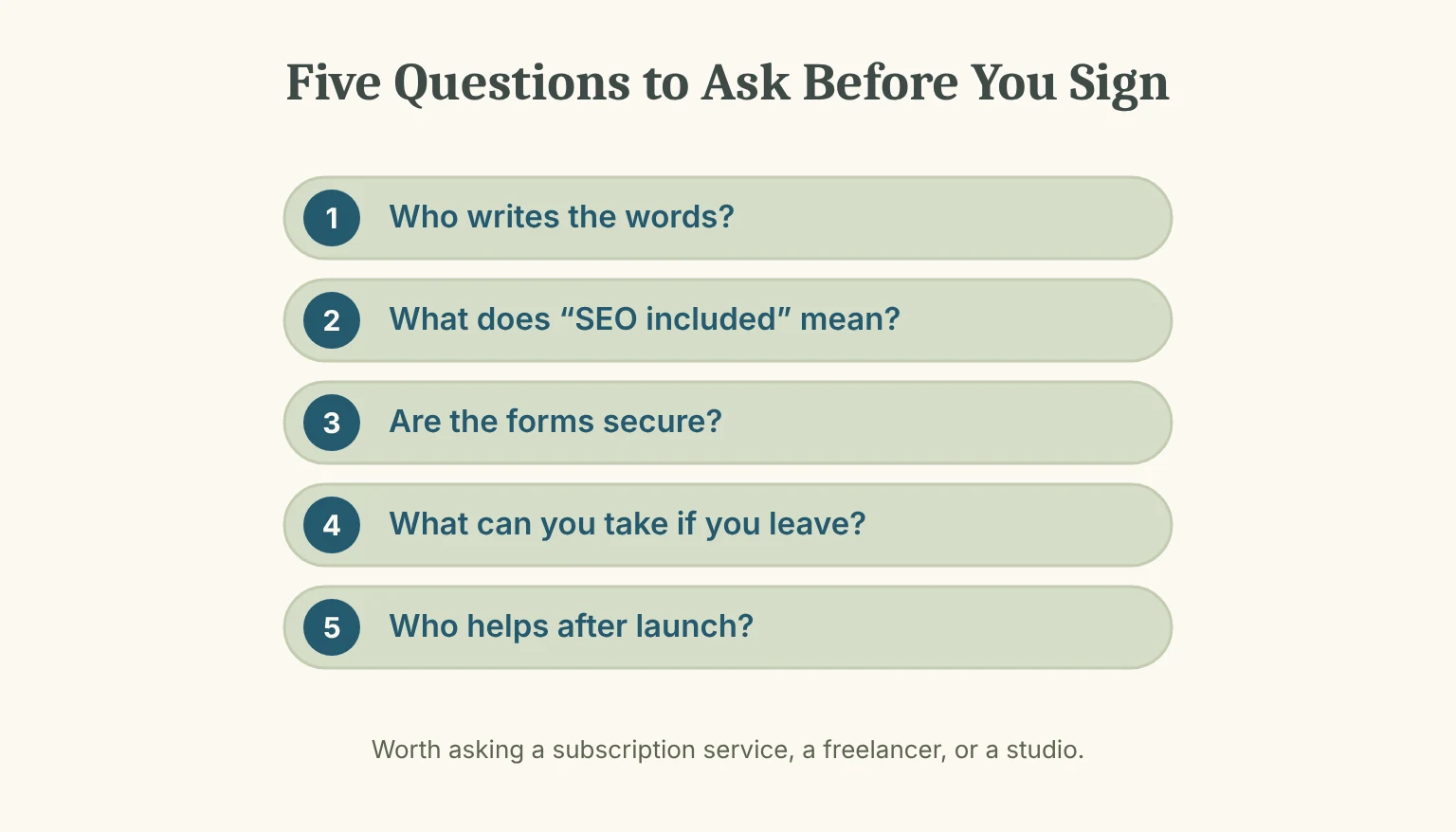
- Who is going to write the website? Is the content original and written with your practice in mind, or will you be adapting prewritten text? And how much help will you get if writing about yourself feels difficult?
- What does “SEO included” actually mean? Does it cover basic technical setup and page titles, or does someone research how people search for your services, plan the pages around those needs, and continue working on visibility after launch?
- Are contact forms and email appropriate for sensitive information? A secure-looking website isn’t the same thing as a suitable system for protected health information. Ask which forms are included, where submissions go, and whether any necessary business associate agreements are available.
- What can you take with you if you leave? Ask separately about your domain name, the words and images on your pages, the design, and the website itself. Can another designer move or rebuild it without starting from zero?
- What happens after launch? Who makes updates, fixes problems, renews software, and helps when something stops working? Is that included, billed separately, or something you’ll manage yourself?
That fourth question is especially easy to overlook. TherapySites distinguishes between content you contribute and content it provides. Brighter Vision says you can keep your domain without a release fee, but it’s still worth asking precisely what happens to your website files and content if you cancel. For our own semi-custom plans, you own your website after the 24-month term, and we can package the files if you want to move it elsewhere. I’d encourage you to ask us the same questions, too.
When I’d choose a subscription website
If you’re newly licensed, still deciding how you want to shape your practice, and mainly need a professional place for referrals to learn about you, I wouldn’t rush into a large custom project.
Your site may need only a warm introduction, a clear description of your services, practical details about fees and availability, and an easy way to reach you. A well-done subscription site can handle those things beautifully.
The same goes if nearly all your clients come through trusted referral relationships and your website’s main job is to reassure someone who’s already heard your name. You may not need an elaborate website strategy just yet.
You can always revisit the decision as your practice becomes more established. Starting with a simpler website isn’t settling. Sometimes it’s the most sensible way to use your budget.
When I’d consider semi-custom or fully custom design
I start leaning toward more tailored design when the website itself needs to do more work.
Maybe you’re building a group practice and want people to find the right clinician without reading six nearly identical bios. Maybe you’ve developed a specialty and need to explain an approach that prospective clients aren’t familiar with. Maybe you’re adding evaluations, intensives, groups, or supervision, and your current website doesn’t really have a place for them.
Or perhaps your practice has simply changed. The site that made sense three years ago now feels like a photograph of a much earlier version of your business.
In those situations, a little more care in the writing, navigation, and page structure can make an enormous difference. Semi-custom may be enough when your needs are fairly straightforward. Fully custom tends to make more sense when there are many moving pieces or when you want to build around a very specific direction.
It also takes more of your input. A designer can guide the process and handle the writing and technology, but understanding what makes your work yours still requires conversation and collaboration. That’s part of what you’re investing in.
Will a custom website automatically do better on Google?
No, and I’d be wary of anyone who promises that.
A custom design isn’t a shortcut to search rankings, and a template doesn’t prevent you from showing up in search results. What matters is whether the website is technically sound, genuinely helpful, well organized, and clear about the services and locations it serves. Ongoing SEO work is a separate service from simply having a website built.
Custom design can give you more freedom to plan the pages and content around your specialties, but somebody still has to do that work. It’s worth asking exactly what your designer means by “SEO-friendly,” rather than assuming the label covers everything.
The most useful way to make the decision
Before looking at another template or portfolio, think about what your website needs to accomplish over the next year.
Does it mainly need to give someone who was referred to you a little confidence before they call? Or does it need to help strangers discover an unfamiliar service, understand several clinicians’ specialties, and decide where to begin?
Then visit your current website, if you have one, and pretend you know absolutely nothing about your practice. In the first few moments, can you tell who the practice helps, what it offers, and how to take the next step?
That’s the part I’d focus on. A beautiful website that leaves people confused isn’t doing its job. A simple website that makes people feel understood, answers their questions, and helps them find their way absolutely is.
If you’d like to talk it through
At Strong Roots, we work with therapists and other mental health professionals at different stages of practice. Sometimes the right fit is semi-custom. Sometimes it’s a fully custom site. And sometimes I’d encourage someone to start with a simpler option and put the rest of their budget toward something more pressing.
If you’re sorting through those choices, you’re welcome to get in touch. I’m happy to hear a little about your practice and help you think through what kind of website would actually be useful right now.