
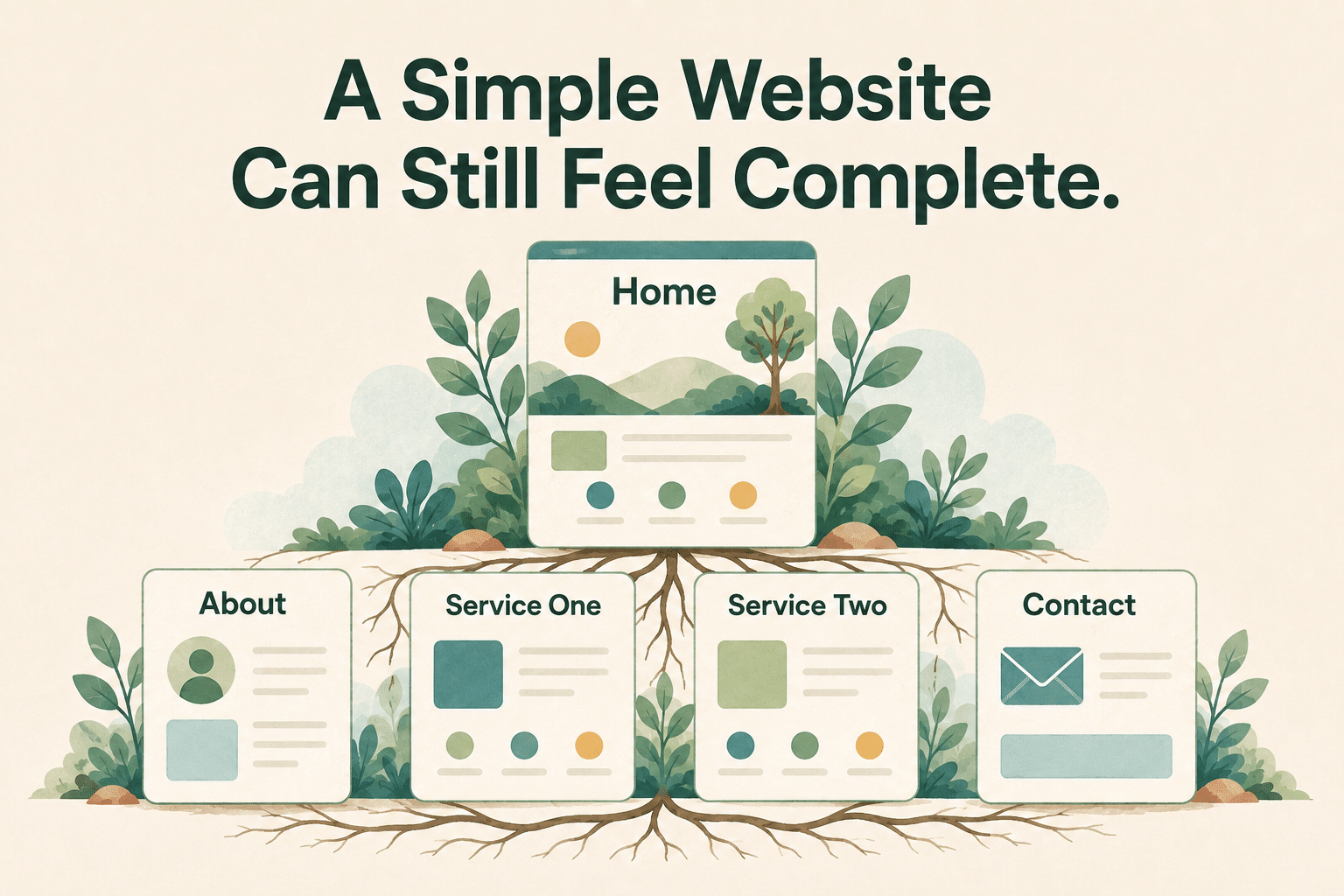
A therapist website needs, at minimum, a Home page, an About page, at least two separate service pages, and a Contact page. That is a solid starting point for most solo therapists. A group practice will usually need additional pages for individual clinicians, more specialized services, locations, and any programs that do not fit neatly within standard therapy services.
That is the short answer. The more useful answer is that your website should be organized around what potential clients need to understand before they feel ready to contact you. It should also give search engines clear, specific information about what you offer, who you help, and where you work.
A five-page website may be exactly right for one therapist and far too limited for another. The goal is not to add pages simply to make the website look substantial. It is to give each important part of your practice enough room to be found, understood, and trusted.
What are the essential pages for a therapist website?
For a solo therapist, I generally recommend beginning with these five pages:
- Home
- About
- Service page one
- Service page two
- Contact
Some practices will need more from the beginning, but these pages create a practical foundation. They introduce your practice, explain the work you do, help the right visitors recognize themselves, and provide a clear next step.
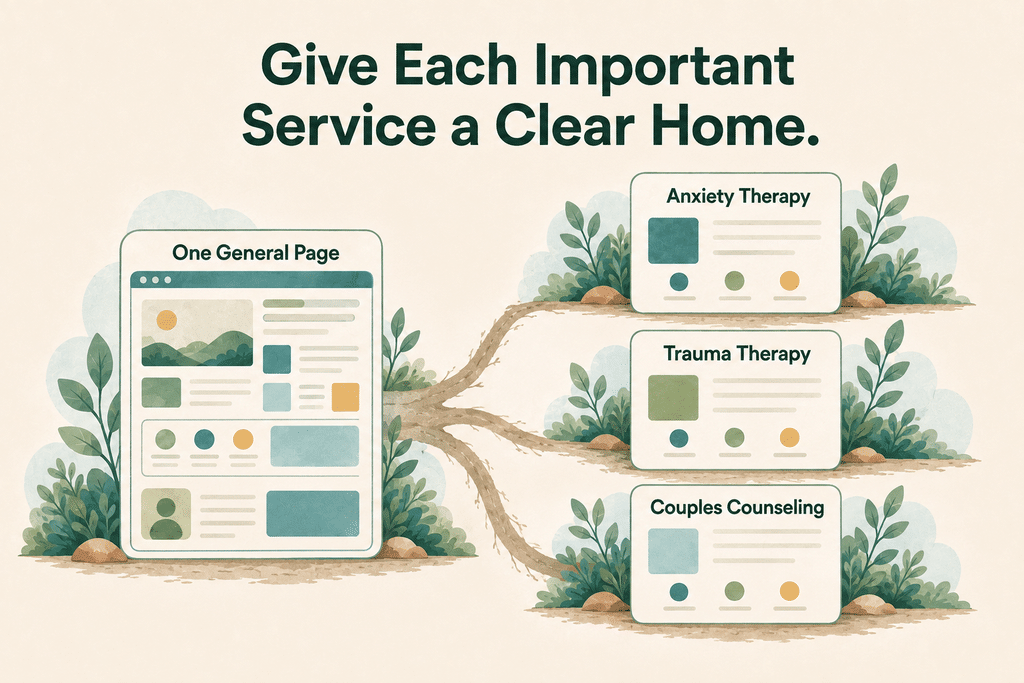
You may notice that I recommend at least two separate service pages rather than placing every service on one general page. That is intentional. People are usually not searching for a generic list of everything a therapist might offer. They are searching for help with a particular concern, in a particular format, or in a particular location. Separate service pages allow you to speak directly to those needs and give Google a much clearer understanding of each service.
What should be included on the Home page?
Your Home page should help a visitor understand, very quickly, whether they are in the right place. It does not need to explain every part of your work. It needs to create a clear path into the rest of the website.
A strong therapist Home page usually includes:
- A clear statement of who you help and what kind of support you provide
- Your primary location or the states where online therapy is available
- A warm introduction to the practice
- A short overview of your main services
- A brief introduction to you or your team
- Trust-building information, such as credentials, experience, or your approach
- A clear call to action that tells visitors how to get started
Your Home page is not supposed to carry the entire website on its shoulders. If every service, specialty, clinician, fee, policy, and frequently asked question is squeezed onto one page, visitors have to work much harder to find what matters to them. A thoughtful Home page gives them orientation and then guides them toward the most relevant next page.
Does a therapist website need an About page?
Yes. Therapy is deeply personal, and potential clients want to know something about the person they may be speaking with before they reach out. An About page helps them understand your approach, your values, your experience, and what it might feel like to work with you.
The strongest therapist About pages do more than repeat a résumé. Your credentials matter, but they are only part of what a potential client is trying to learn. The page should connect your training and experience to the way you help people. It should also sound like a real person, rather than a formal professional biography copied from a directory profile.
For a solo therapist, the About page can often include practical information such as fees, insurance, session format, and availability. This is especially helpful when those details do not need a full page of their own.
A simple test is to ask: after reading this page, will the right client have a clearer sense of who I am, how I work, and whether they may feel comfortable talking with me?
Why should therapists have separate service pages?
Separate service pages are one of the most important parts of a therapist website structure, particularly when organic search matters.
Imagine that a potential client searches for trauma therapy, couples counseling, postpartum support, or psychological testing. A single Services page containing two sentences about each offering is unlikely to answer that person’s questions fully. It also gives Google very little focused information about any one service.
A dedicated service page creates room to explain:
- Who the service is for
- The concerns that may lead someone to seek help
- What the service involves
- Your particular approach or perspective
- How the service is offered
- Where it is available
- What the next step looks like
This does not mean every small variation needs its own page. It means that the services you actively want people to find should generally have enough space to stand on their own.
How do you decide whether a service needs its own page?
A separate service page is usually worthwhile when at least one of the following is true:
- It is a meaningful part of the practice and you want more inquiries for it.
- Potential clients commonly search for it by name.
- It serves a distinct audience with different questions or concerns.
- It requires more explanation than a short paragraph can provide.
- It has a different process, fee structure, format, or call to action.
- It supports an important SEO goal.
For example, anxiety therapy and couples counseling are different enough that they usually deserve separate pages. The people searching for them are bringing different concerns, asking different questions, and looking for different kinds of reassurance.
On the other hand, you may not need a separate page for every therapeutic technique you sometimes use. EMDR, CBT, ACT, or play therapy may warrant dedicated pages when they are central services or meaningful search targets. If they are simply tools you draw upon within a broader service, they may fit more naturally within the relevant service page.
Does every therapist need a separate page for every specialty?
Not necessarily. More pages are not automatically better for SEO.
A page needs a clear purpose and enough original, useful information to justify its existence. Creating ten nearly identical pages and changing only the name of the condition rarely produces a helpful website. It can make the site feel repetitive, dilute the strongest information, and create pages that compete with one another.
A better approach is to group closely related concerns when that makes sense for the client, and create separate pages when the search intent or service truly differs.
For example, stress, overwhelm, and burnout may fit together on one carefully developed page. Psychological evaluations and weekly individual therapy almost certainly should not. The right structure comes from the way potential clients understand and seek the service, not simply from the number of keywords on a list.
What pages does a group therapy practice need?
A group practice website has a more complicated job. It needs to explain the practice as a whole while also helping visitors understand its individual clinicians, services, locations, and ways of getting started.
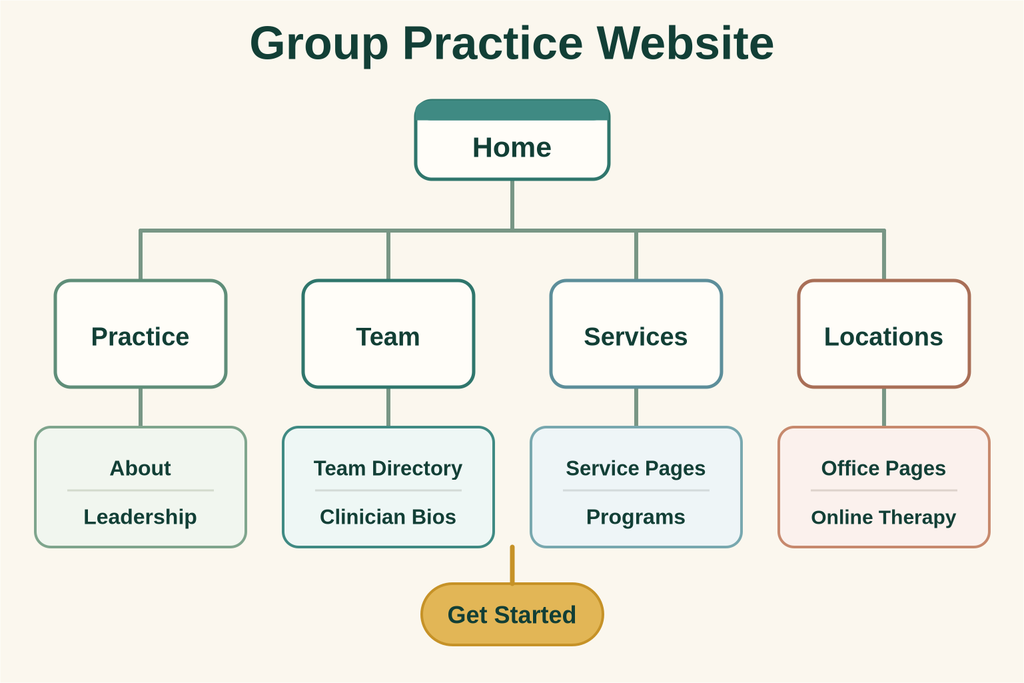
Most group practice websites will need:
- A Home page
- An About the Practice page
- A team or clinician directory
- Individual clinician bio pages
- Separate pages for the practice’s primary services
- A Contact or Get Started page
- Location pages when the practice has multiple offices or a location-focused SEO strategy
- Separate pages for groups, evaluations, intensives, supervision, or other distinct programs
The larger the practice becomes, the more important information architecture becomes. Visitors should not have to open twelve clinician biographies and keep mental notes about who treats anxiety, who accepts adolescents, and who has openings on Tuesdays. The website should help people narrow their choices without making the process feel clinical or overwhelming.
Does every clinician need an individual bio page?
In general, I recommend giving each clinician an individual bio page. There are exceptions, especially for very large practices, but individual pages offer several important advantages.
A clinician bio page gives potential clients room to learn about that therapist’s specialties, approach, populations served, availability, and personality. It also gives the practice a specific page to link to from service pages, directories, referral sources, and search results.
For a small or midsize group practice, a strong structure usually includes both:
- A team directory that makes it easy to compare clinicians at a glance
- A dedicated page where each clinician can speak more fully to potential clients
The directory should help someone choose where to click. The individual page should help them decide whether to reach out.
For a very large practice, maintaining dozens of full biographies can become cumbersome. Even then, the solution is usually a better filtering and profile system, not eliminating useful clinician information altogether.
When does a therapist website need location pages?
Location pages are primarily an SEO decision. They can help a practice establish relevance for searches connected to a particular city, neighborhood, or office, but only when the page represents a real and meaningful connection to that location.
A location page is most useful when:
- The practice has a physical office in that location.
- The practice has multiple offices and visitors need information about each one.
- Services, clinicians, directions, parking, accessibility, or availability differ by location.
- The practice has a legitimate SEO strategy focused on reaching clients in that area.
A useful location page should contain more than a city name inserted into generic text. It should help someone understand what is available there, which clinicians work there, how to reach the office, and what they should do next.
Online therapy requires a slightly different approach. A therapist licensed throughout a state can usually explain statewide online availability clearly without manufacturing a page for every city in that state. Location pages should reflect a genuine service and a useful distinction, not simply an attempt to create as many keywords as possible.
Do groups, evaluations, intensives, and supervision need separate pages?
Usually, yes, when they are active offerings that the practice wants people to find.
These services often have different audiences, expectations, schedules, and decision-making processes than ongoing individual therapy. Giving them separate pages makes the information easier to understand and easier to find.
Therapy groups
A therapy group page should explain who the group is for, what participants can expect, when and where it meets, whether it is currently accepting members, the cost, and how to inquire. If the practice regularly runs very different groups, each important group may need its own page.
Psychological and forensic evaluations
Evaluations should generally be separated from therapy services. The purpose, process, timeline, documentation, and referral pathways are different. A parent seeking an autism evaluation and an adult seeking weekly therapy should not have to sort through the same page to understand what happens next.
Intensives
An intensive often requires more education because potential clients may not be familiar with the format. Its page should clarify how it differs from weekly therapy, who may benefit, how long it lasts, and how readiness is determined.
Clinical supervision and professional services
Supervision, consultation, training, and speaking services address professional audiences rather than therapy clients. Separate pages prevent mixed messaging and allow each audience to find the information meant for them.
Where should fees and frequently asked questions go?
A therapist website does not automatically need a separate Fees page or FAQ page.
For a solo therapist, fee and insurance information can often fit naturally on the About page. It may also belong on the Contact page when people need that information immediately before reaching out.
Frequently asked questions can often be more useful when they appear on the page where the question arises. Questions about teletherapy belong on the online therapy page. Questions about an evaluation timeline belong on the evaluation page. Questions about group availability belong on the relevant group page.
A separate FAQ page becomes useful when the practice has a substantial set of general questions that apply across services. The important thing is not whether the page is called FAQ. The important thing is that visitors can find the answers at the moment they need them.
Should a therapist website have a blog or resource center?
A blog is not one of the minimum pages required to launch a therapist website. It can be valuable, but only when the practice has a clear purpose for it and the ability to publish useful content.
For SEO, educational content can help a website develop authority around the services it provides. It can answer the more detailed questions potential clients ask before they are ready to contact someone. It can also create natural pathways into service pages.
However, a collection of short, generic articles is unlikely to accomplish much. A smaller number of thoughtful, experience-based resources is often more useful than publishing frequently simply to keep a blog active.
For an established practice, a curated learning center can be especially effective. It allows the most valuable resources to be organized by the questions and stages that matter to readers, rather than by publication date alone.
Sample sitemap for a solo therapist website
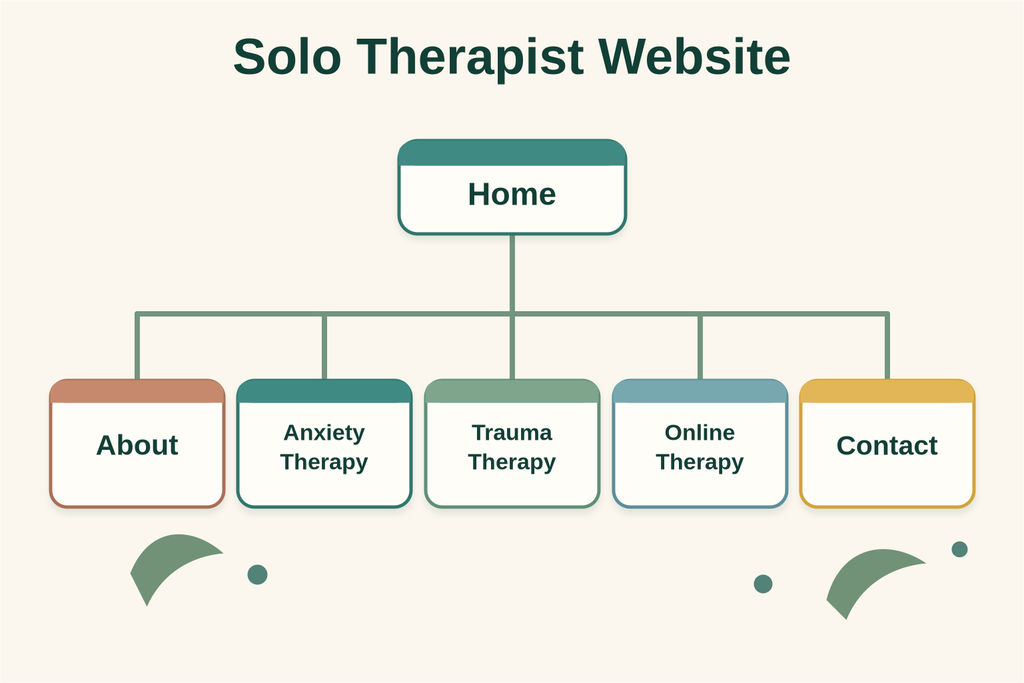
A therapist offering anxiety therapy, trauma therapy, and online therapy might use this structure:
- Home
- About
- Anxiety Therapy
- Trauma Therapy
- Online Therapy
- Contact
Fee and insurance information could be included on the About or Contact page. Relevant questions about online sessions could be answered directly on the Online Therapy page.
This structure is still approachable for visitors, but it gives each major service enough room to be clear and searchable.
Sample sitemap for a small group practice
A small group practice with four clinicians might use:
- Home
- About Our Practice
- Meet Our Therapists
- Individual bio page for each therapist
- Anxiety Therapy
- Trauma Therapy
- Couples Counseling
- Child and Adolescent Therapy
- Contact or Get Started
The team directory can identify each clinician’s specialties and populations served. Individual bios can provide a more personal introduction, while service pages explain how the practice approaches each area of care.
Sample sitemap for a larger or multi-location practice
A larger practice may need several organized layers:
- Home
- About the Practice
- Leadership
- Meet the Team
- Individual clinician pages
- Services overview
- Separate pages for each primary service or specialty
- Programs, groups, evaluations, or intensives
- Locations overview
- Individual office location pages
- Resources
- Contact or Get Matched
This does not mean every item belongs in the main navigation. A large website can contain many useful pages while keeping the primary menu calm and focused. Thoughtful dropdowns, filters, related links, and clear calls to action can help visitors move through the site without being presented with every option at once.
Common mistakes when planning therapist website pages
Putting every service on one page
This may feel simpler, but it often leaves important services underexplained. It can also limit the website’s ability to appear for specific searches.
Creating a page for every possible keyword
The opposite problem is creating many thin, repetitive pages. Each page should have a clear audience, purpose, and genuinely useful content.
Organizing the website around the practice instead of the visitor
Internal departments, professional terminology, and organizational charts may make sense to the team while confusing potential clients. The site’s labels and pathways should reflect how visitors describe their needs.
Making clinician selection feel like homework
A long wall of headshots and biographies is not enough for a growing group practice. Visitors need help understanding specialties, availability, age groups, locations, and other meaningful differences.
Hiding the next step
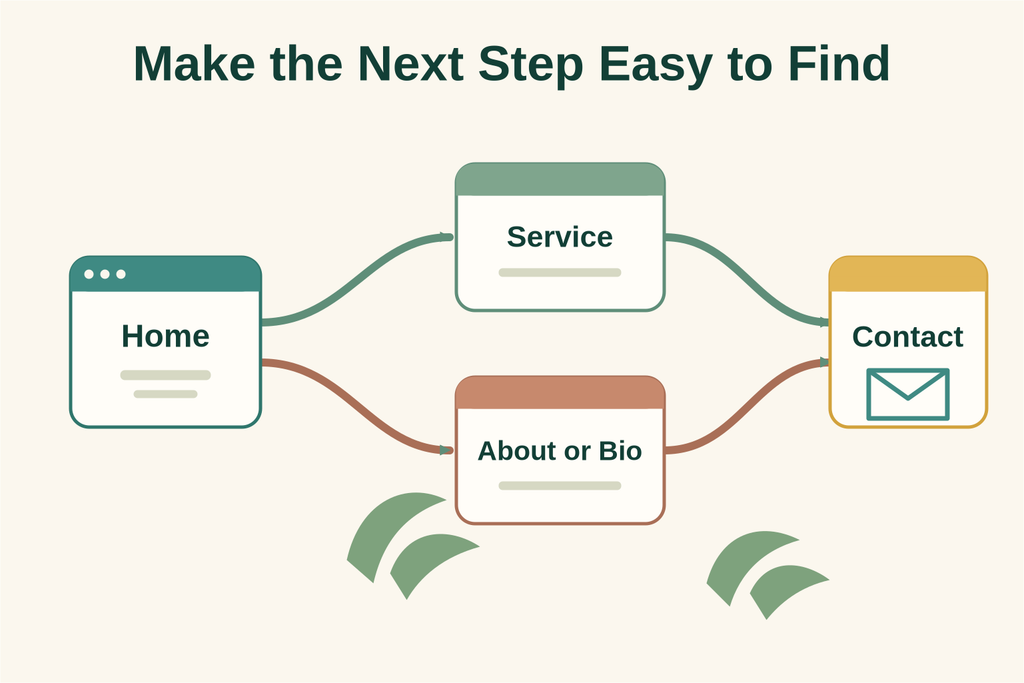
Every important page should make it clear how someone can ask a question, request a consultation, join a waitlist, or begin the intake process. Contact information should be easy to find, especially for visitors using a phone.
Forgetting that the structure needs to grow
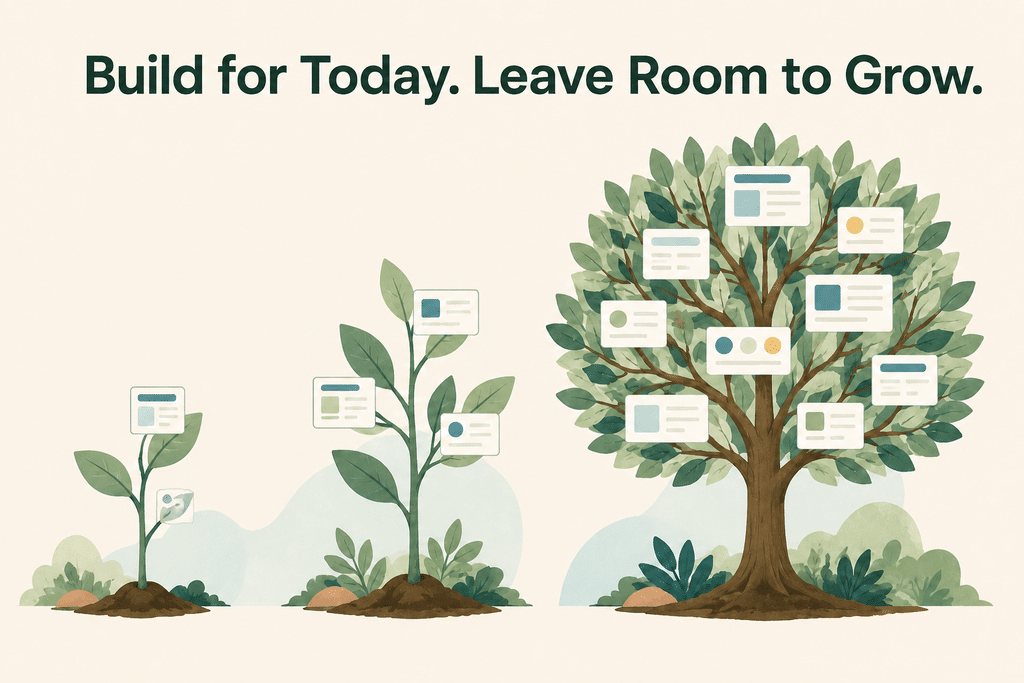
A five-page structure may work beautifully when a therapist launches. It may become confusing after the practice adds six clinicians, three offices, evaluations, groups, and professional training. The website should be reviewed as the practice evolves.
Therapist website planning checklist
Before finalizing your sitemap, ask:
- Can a new visitor understand who we help and what we offer from the Home page?
- Does the About page help the right clients understand what working with us may feel like?
- Does every primary service have enough information to stand on its own?
- Are closely related concerns grouped thoughtfully rather than split into repetitive pages?
- Can potential clients find the right clinician without opening every bio?
- Does each clinician who needs one have a useful individual page?
- Are groups, evaluations, intensives, and professional services clearly distinguished from standard therapy?
- Do location pages represent real offices or a legitimate location-focused strategy?
- Are fees, insurance, availability, and common questions placed where visitors will look for them?
- Does every page give the visitor a clear next step?
- Can the structure expand as the practice grows?
- Does each page provide genuinely useful information rather than existing only for a keyword?
How many pages should your therapist website have?
There is no ideal number that applies to every practice.
A solo therapist with two primary services may have an effective five-page website. Another solo therapist may need separate pages for several specialties, online therapy, clinical supervision, and more than one state. A growing group practice may need dozens of pages to represent its clinicians, locations, and programs clearly.
The right number is the number required to help potential clients find the relevant information without becoming lost or overwhelmed.
Your website structure should be simple, but simple does not always mean small. Sometimes simplicity comes from giving each important idea a clear home.
A thoughtful website structure supports both people and search engines
When therapist website pages are planned well, visitors do not need to work hard to understand the practice. They can recognize the services that fit their needs, learn about the therapist or team, find practical information, and take the next step with confidence.
The same structure also helps search engines understand the relationships between your services, clinicians, locations, and areas of expertise. That creates a stronger foundation for SEO than trying to fit everything onto one page or publishing dozens of disconnected articles.
If you are planning a new therapist website or trying to reorganize one that has grown increasingly complicated, begin with the people who will use it. What are they searching for? What do they need to understand? What might make the process feel easier?
The answers to those questions will usually lead you toward the right pages.
If you’re mapping out your site structure, these guides can help:
- What Is Website Hosting? A Beginner’s Guide for Therapists
- Squarespace vs WordPress for Therapists
- How to Organize a Group Practice Website Without Overwhelming Visitors
Need help planning your therapist website?
Strong Roots Web Design specializes in thoughtful websites and SEO for therapists, psychologists, psychiatrists, and mental health practices. We can help you create a website structure that fits your practice now and gives it room to grow.
Explore our semi-custom and fully custom website options, or schedule a conversation to talk through what your practice needs.