
A clear, service-first structure can help prospective clients understand their options, feel supported, and take the next step.
If your group practice has several therapists, multiple specialties, more than one location, or a growing list of services, organizing the website can start to feel like a complicated puzzle.
You want prospective clients to see the full breadth of what your practice offers. You also want each clinician to feel represented, each service to be easy to find, and every important detail to have a home. But if you put everything everywhere, the website can become crowded and confusing.
The goal is not to show visitors every possible option at once. It is to help them answer a few important questions in a calm, natural order:
Do you help with what I am looking for?
Can I receive that help in a way that works for me?
What happens if I reach out?
For most therapy practices, the clearest group practice website structure begins with services. Prospective clients are usually searching for help with a concern or for a particular kind of therapy. They are less likely to begin by searching for the name of a clinician unless they already know that person.
A strong website therefore helps visitors find the right service first, learn which clinicians can provide it, and understand how the practice will support them in choosing a good fit.

The short answer: How should a group practice website be organized?
A group practice website should usually be organized around the services prospective clients are seeking, with clear pathways to individual clinician profiles, location information, and the intake process.
A practical structure includes:
- A focused homepage
- A services overview page
- Separate pages for important services and specialties
- A team overview page
- An individual bio page for each clinician
- An About page
- A clear Contact or Get Started page
- Optional location pages, FAQ content, fees information, and educational resources
These pages should not function as separate islands. Service pages should link to the clinicians who offer that service. Clinician bios should link back to their areas of specialty. Location pages, when appropriate, should explain what is available at each office. The contact process should remain consistent throughout the site.This is what people type into their browser to find your website.
Why group practice websites become overwhelming
A solo therapist website often has a relatively simple job. It needs to introduce one person, explain a focused set of services, build trust, and make it easy to reach out.
A group practice website has more moving parts. It may need to represent:
- Several clinicians with different backgrounds and specialties
- Services for different ages, concerns, or types of clients
- Multiple therapy approaches
- In-person and online therapy
- More than one office location
- Different fees, insurance arrangements, or schedules
- Groups, evaluations, supervision, workshops, or other offerings
The problem is rarely that the practice has too much valuable information. The problem is that the information has not been organized around the decisions a prospective client is trying to make.
A visitor who is already anxious, overwhelmed, or uncertain should not have to study your practice like an organizational chart. Your website should gently guide them.
Start with what prospective clients are actually looking for
When I organize a group practice website, I generally begin with services because that is how most prospective clients search.
Someone may look for anxiety therapy, couples counseling, trauma treatment, psychological testing, therapy for teens, or another specific form of support. They are usually not beginning with the question, “Which clinician at this practice do I want?”
This matters for both usability and SEO. A dedicated service page gives you space to explain the concern, describe your practice’s approach, answer common questions, and clearly identify who you help. It also gives search engines and AI tools a focused page to understand and potentially surface for a relevant query.
If every service is briefly mentioned on one general page, none of them may receive enough depth or clarity. Separate service pages allow important specialties to have a clear home.This is the actual experience people interact with when they visit your site.
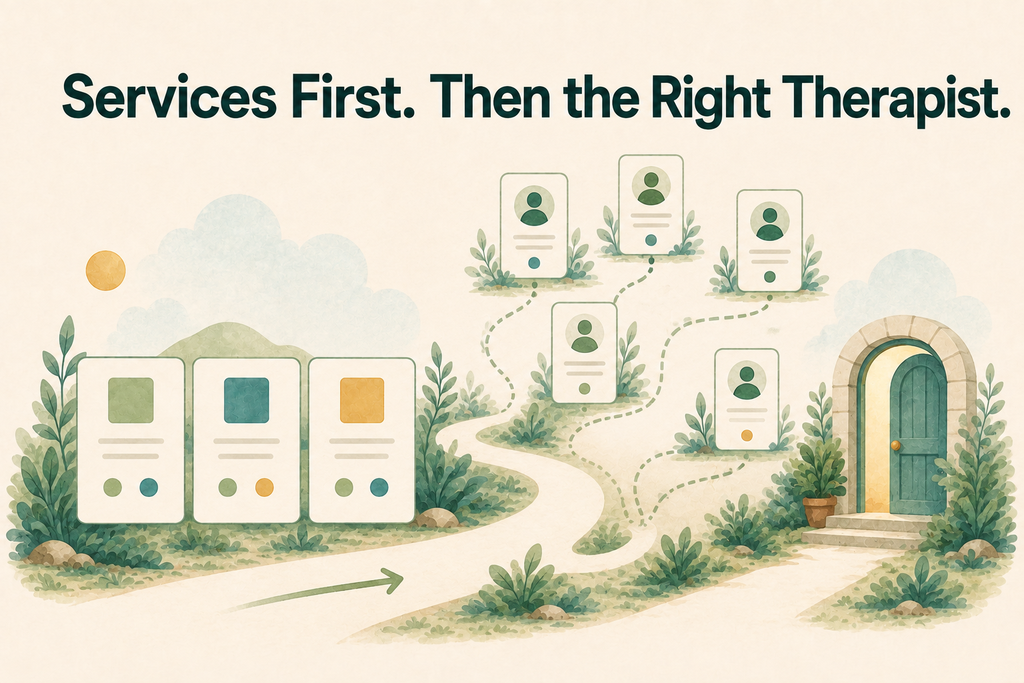
Build the website around a service-first pathway
A service-first structure does not mean hiding the team. It means introducing information in the order that is most useful to a new visitor.
A simple path might look like this:
1. The visitor arrives on the homepage or a service page.
2. They confirm that the practice works with the concern they are experiencing.
3. They learn which clinicians offer that service.
4. They read one or more clinician bios if they want to.
5. They review practical information about location, online therapy, fees, or insurance.
6. They contact the practice and understand what will happen next.
This pathway gives visitors useful choices without asking them to make every decision alone.
The core pages most group practice websites need
The exact number of pages will depend on the size and complexity of the practice. Still, most group practice websites benefit from the following foundation.
1. A focused homepage
The homepage should orient visitors, not explain every detail.
It should quickly communicate:
- Who the practice helps
- The main services or areas of focus
- Where services are available
- What makes the practice feel distinct
- How to take the next step
You can introduce the team, highlight several primary services, and briefly explain the practice’s approach. Each section should point visitors toward a more detailed page.
A homepage becomes overwhelming when it tries to contain the entire website. Think of it as a welcoming entry point and a clear set of signposts.
2. A services overview page
A services overview page gives visitors a manageable picture of the support available across the practice.
This page can group related services into clear categories. For example, a practice might organize offerings by the type of client, the concern being treated, or the format of care. The best categories are the ones prospective clients will understand easily.
Avoid relying only on clinical language or modality names if your ideal clients are unlikely to search that way. A person may know they need help with anxiety without knowing whether they need CBT, ACT, psychodynamic therapy, or another approach.
Each priority service should link to its own page.
3. Separate pages for important services and specialties
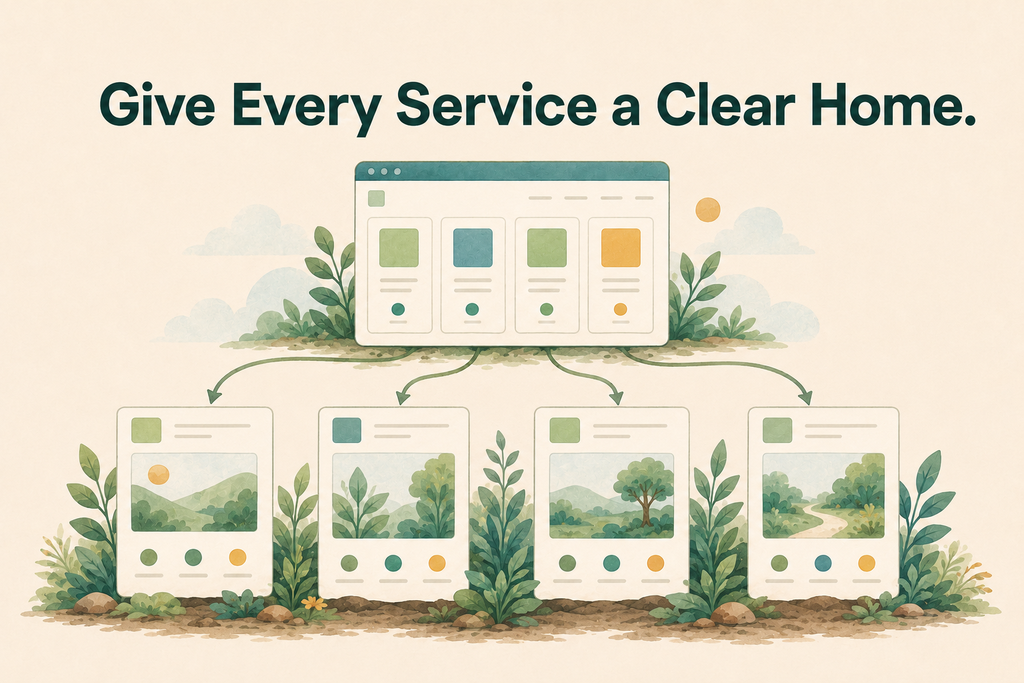
Individual service pages are among the most important parts of a group practice website.
Each page should focus on one meaningful service or search need, such as:
- Anxiety therapy
- Trauma therapy
- Couples counseling
- Therapy for teens
- Perinatal mental health
- Psychological testing
- ADHD evaluations
- Grief counseling
A strong service page should answer the questions a prospective client is likely to have. It can explain who the service is for, what concerns may bring someone to therapy, how the practice approaches the work, what a client can expect, and how to begin.
It should also identify the clinicians who provide that service. This creates a natural bridge between what the visitor needs and the people who can help.
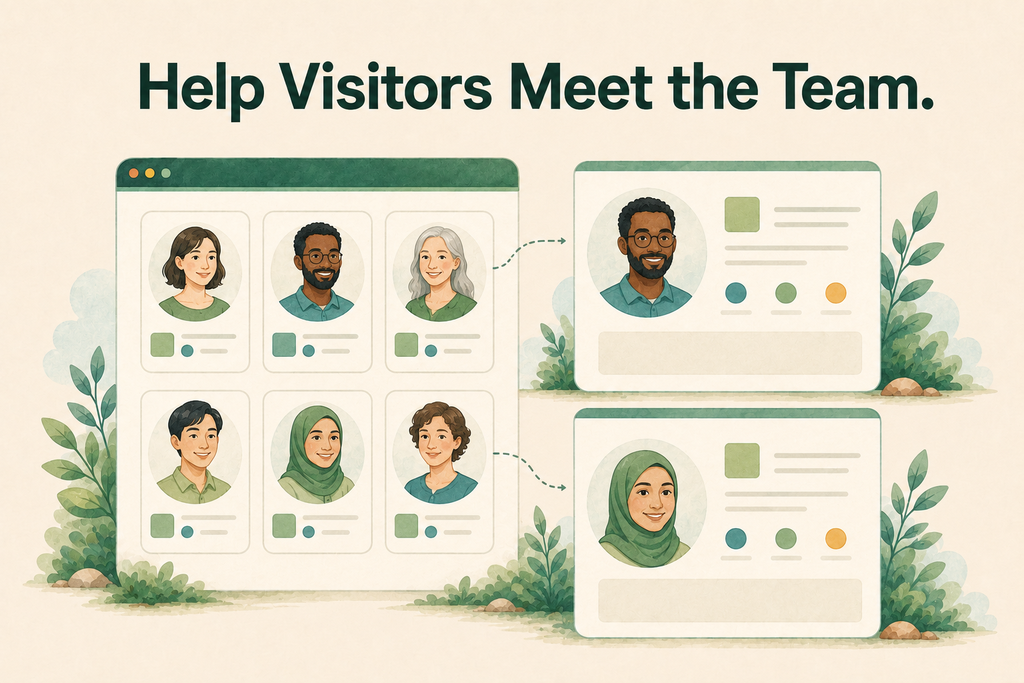
4. A team overview page
The team page should make the practice feel approachable while helping visitors narrow their options.
For a smaller practice, a simple grid of clinician photos, credentials, short introductions, and specialties may be enough. A larger practice may need more organization, such as grouping clinicians by location or making specialties easy to scan.
The page should not force a visitor to read ten full biographies in one long scroll. Give each clinician a concise summary and a link to a dedicated bio page.
If you include filters, keep them genuinely useful. A long collection of overlapping filters can create more work instead of less. The aim is to make the team easier to understand, not to turn the process into online shopping.
5. An individual bio page for every clinician
In general, I recommend giving each clinician an individual bio page.
A dedicated bio page gives prospective clients enough space to get a feel for the clinician without making the main team page unmanageably long. It also provides a clear page for people who search for that clinician by name.
A helpful therapist bio page may include:
- A warm introduction
- The clients and concerns the clinician works with
- Their therapeutic approach in accessible language
- Relevant training and credentials
- Ages or populations served
- Services offered
- Office location or online availability
- A clear next step
The page should sound human. Credentials matter, but most prospective clients also want to understand what it may feel like to sit with this person.
6. An About page that explains the practice as a whole
The About page is where you can tell the larger story of the practice.
It may include the founder’s vision, the values shared by the team, the practice’s approach to care, and the experience you want clients to have. It can help the group feel cohesive instead of looking like a directory of unrelated clinicians.
Depending on the website, practical information such as fees or insurance may also fit naturally here. The most important thing is that visitors can find it without digging.
7. A clear Contact or Get Started page
The Contact page should do more than provide a form. It should explain what happens after someone uses it.
Prospective clients may be wondering:
- Who will receive my message?
- Will I speak with a clinician or an intake coordinator?
- Do I need to choose a therapist before reaching out?
- How will the practice help me find a good fit?
- When should I expect a response?
- What information will I need to provide?
Setting clear expectations can make reaching out feel safer and easier. It also reduces confusion for people who are not sure which clinician is right for them.
If your practice offers matching support, say so directly. A visitor should understand that they do not need to solve the entire puzzle before contacting you.ite and improve it gradually than to stay stuck waiting for the perfect version.
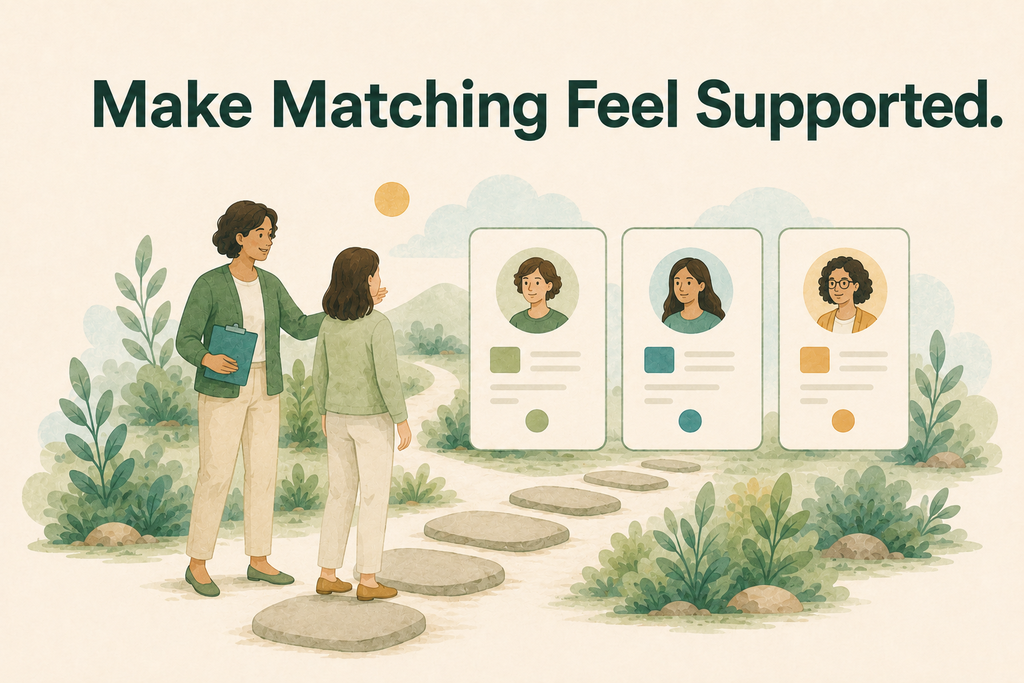
Make the intake process part of the website structure
For a group practice, the intake process is part of the user experience. It should not appear only in a small sentence next to the contact form.
Explain who the prospective client will speak with, what that first conversation will cover, and how the practice will help identify the best clinician or service. If the process differs for therapy, testing, groups, or other offerings, explain those differences on the relevant pages.
Clear intake information serves two important purposes. It lowers the emotional barrier to reaching out, and it prevents the website from placing too much responsibility on the visitor.
A group practice can offer something a solo clinician often cannot: support with matching. Your website should make that benefit visible.
Connect services and clinicians through internal links
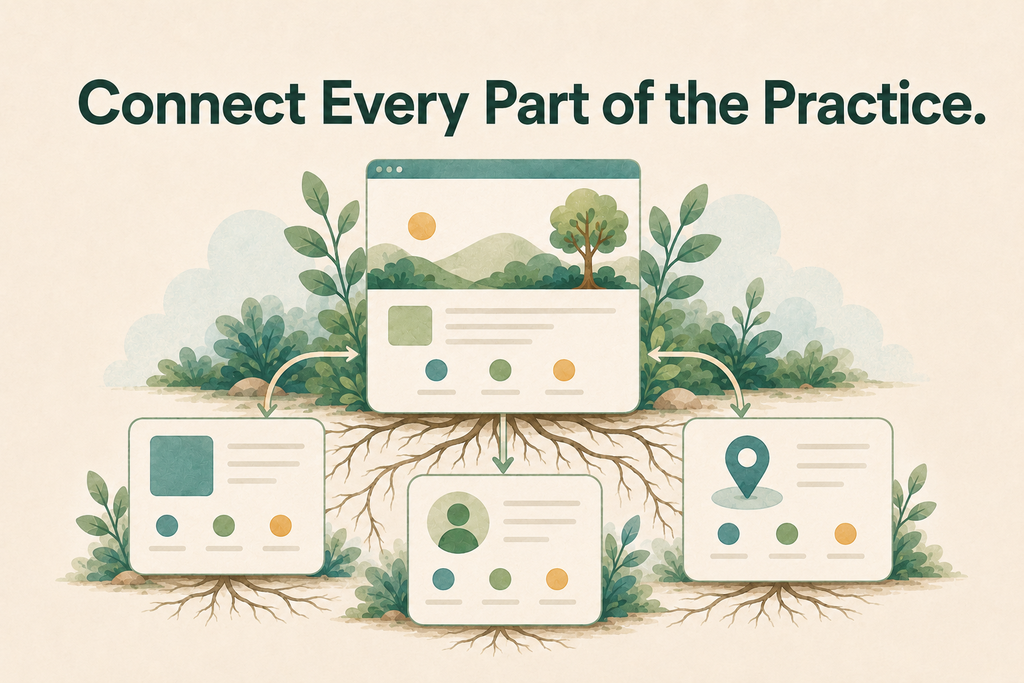
A clear group practice website is not only a collection of well-written pages. The relationships between those pages matter.
On each service page, link to the clinicians who provide that service. On each clinician bio, link to the relevant service pages. If a clinician works from a particular location, make that information clear and link to the location page when one exists.
This internal linking helps visitors move through the website naturally. It also helps search engines understand how your services, team, and locations relate to one another.
For example, someone reading about trauma therapy should be able to move directly to the bios of the clinicians who offer trauma therapy. A visitor reading a clinician’s bio should be able to learn more about that clinician’s primary specialties without returning to the main menu.
When should a group practice create location pages?
Location pages can be valuable for local SEO, particularly when a practice has multiple physical offices. However, they are not always the first priority.
Start by making sure the main service pages and essential website structure are strong. Then consider separate location pages when:
- The practice has more than one established office
- People search for services in distinct cities or neighborhoods
- Services or clinicians differ by location
- Each office has meaningful, location-specific information
- Local visibility is an important growth goal
A useful location page should contain more than an address and a map. It may explain which services are offered, which clinicians work there, what the office is like, how to arrive, accessibility details, and how to request an appointment.
Bridges of the Mind, a Strong Roots client, provides therapy and psychological evaluations across Sacramento, San Jose, and South Lake Tahoe. For a multi-location practice like this, clear service information and thoughtful location pathways help visitors understand both what is offered and where they can receive it.
Avoid creating thin, nearly identical location pages that simply swap one city name for another. Each page should provide genuine value to someone considering care at that location.evolve.
How to keep a large group practice website from feeling cluttered

A practice can have a complex structure without giving visitors a complicated experience. The following principles help.
Use plain, familiar labels
Navigation labels such as Services, Our Team, About, Locations, and Contact are easy to understand. Clever labels may feel creative, but they can make visitors stop and wonder where to click.
Keep the main navigation focused
Not every page needs to appear in the main menu. Use dropdowns thoughtfully, and place secondary pages in the footer or link to them from relevant content.
If the Services dropdown contains an intimidating list, group related offerings under an overview page or a small number of understandable categories.
Reveal detail gradually
Give visitors a clear summary first, then let them choose whether to learn more. The homepage can introduce services. The services overview can organize them. Individual service pages can provide depth.
This is much easier to navigate than placing every detail on the homepage.
Use consistent page patterns
Service pages should generally follow a similar structure. Clinician bios should include comparable types of information. Calls to action should use consistent language.
Consistency helps visitors learn how the website works. It also makes the site easier to expand as the practice grows.
Write for a person who may already feel overwhelmed
Short paragraphs, meaningful headings, readable text, white space, and clear buttons all matter. A calm website is not only a visual preference. It makes important information easier to absorb.
Common group practice website structure mistakes
Even a beautiful website can be difficult to use if the underlying organization is unclear. These are some of the most common problems I see.
Putting every service on one page
A single services page may seem simpler, but it often makes important offerings harder to explain and harder to find through search. Give priority services their own pages.
Organizing the entire website around clinicians
Clinician information is essential, but new visitors generally begin with their needs. Lead with services, then connect those services to the right people.
Making visitors choose a therapist before they can contact you
Some people know exactly whom they want to see. Many do not. Let visitors contact the practice without making a final clinician choice, and explain how you will support the matching process.
Using one long team page instead of individual bios
A very long team page can be tiring to scan and gives each clinician too little room to connect with prospective clients. Use short team summaries that lead to full bio pages.
Hiding practical information
Do not make people hunt for location, online therapy availability, fees, insurance information, or the next step. These details can live on different pages, but the path to them should be clear.
Creating too many nearly identical pages
More pages do not automatically create better SEO. Every service or location page should have a distinct purpose and useful content. Thin or repetitive pages can make the website feel larger without making it more helpful.

Plan a structure that can grow with the practice
A group practice website should work for the practice you have today while leaving room for what may come next.
Use repeatable structures for clinician bios, service pages, and location pages. Decide how new clinicians will be added, how availability will be communicated, and who will keep details current. Think ahead about what happens when a clinician leaves, a new specialty is introduced, or another office opens.
This does not mean building pages for plans that may never happen. It means creating an organized foundation so that growth does not require starting over.
A sample group practice website structure
For many therapy group practices, a clear sitemap might look like this:
Home
About the Practice
Services
- Anxiety Therapy
- Trauma Therapy
- Couples Counseling
- Therapy for Teens
Our Team
- Individual Clinician Bio
- Individual Clinician Bio
- Individual Clinician Bio
Locations, if appropriate
- Location One
- Location Two
Fees and Insurance, if needed as a separate page
Resources or Learning Center
Contact or Get Started
The precise labels and number of pages should reflect the practice. The underlying logic is what matters: services first, people connected to those services, practical information where it is needed, and one clearly explained path to care.
Group practice website structure FAQ
Should every therapist in a group practice have a separate bio page?
In most cases, yes. An individual page gives each clinician room to explain their specialties, approach, experience, and availability. It also creates a direct result for people searching for that clinician by name.
Should services or clinicians come first in the navigation?
For most group practices, services should receive priority because prospective clients typically begin by looking for help with a concern or a particular type of therapy. Clinician pages should be easy to reach from both the team page and the relevant service pages.
How many service pages does a group practice need?
There is no universal number. Create separate pages for the services and specialties that are important to the practice, meaningfully different from one another, and relevant to what prospective clients search for. Avoid creating pages that repeat nearly identical content.
Does a group practice need separate location pages?
Not always. Location pages are particularly useful for practices with multiple physical offices or a local SEO strategy focused on distinct areas. Strong service pages and essential website content are usually the first priority.
Should visitors be able to contact the practice without choosing a clinician?
Usually, yes. Many prospective clients do not know which therapist will be the best fit. Explain how the intake process works and how the practice will help them find an appropriate clinician.
Can a large group practice website still feel simple?
Yes. Simplicity does not require having very little information. It comes from organizing information in layers, using clear labels, creating consistent page patterns, and guiding visitors toward one decision at a time.
Related reading:
- What Pages Every Therapist Website Needs
- What Is Website Hosting? A Beginner’s Guide for Therapists
- Squarespace vs WordPress for Therapists
A clear website can make a large practice feel more personal
A group practice website has to represent many people and services, but it should never feel like a database.
When the structure begins with what prospective clients need, connects those needs to the right clinicians, and clearly explains how the practice will help, the website becomes easier to use and more reassuring.
The best group practice website structure does not ask visitors to understand everything at once. It helps them recognize that they may be in the right place and shows them one manageable next step.
If your practice has grown beyond what your current website can comfortably hold, Strong Roots Web Design can help you create a clear, thoughtful structure that supports your clients, your team, and the next stage of your practice.