
You’ve googled yourself. Everybody does, and there’s nothing embarrassing about it.
You typed in “therapist in [your city]” and you scrolled. And there was Psychology Today, and there was GoodTherapy, and there was some directory you’ve never heard of, and there were three practices in a little map box at the top, and you were nowhere. Not on the first page. Maybe not on the third.
Meanwhile you know — you actually know, because you’ve sat with them — that there are people in your town right now who need exactly the kind of help you’re trained to give.
So let’s talk about how this works, because local search is genuinely different from the rest of SEO, and most of the advice out there wasn’t written with therapists in mind.
The short answer
Showing up locally comes down to two separate things: your Google Business Profile, which controls whether you appear in the map results at the top of the page, and your website, which controls whether you appear in the ordinary blue-link results underneath.
They’re ranked differently, they’re won differently, and for most therapy practices the map results are both the easier win and the more valuable one.
If you do one thing after reading this: claim and completely fill out your Google Business Profile. It’s free, it takes an afternoon, and for a local practice it’s the single biggest lever there is.
First, is this actually your problem?
Before you spend a weekend on this, it’s worth knowing which problem you have — because “nobody is contacting me” has two very different causes and they need opposite fixes.
Search for your practice name directly. If your site comes up, you’re findable — people just aren’t finding you when they search for help rather than for you. That’s what this article is about.
But if people are landing on your site and not reaching out, that’s a different problem entirely, and more search visibility won’t fix it. That’s a clarity problem, and it lives on the page rather than in Google.
Most practices have some of both. It’s just useful to know which one is costing you more.
Two sets of results, two different battles
Search for a therapist in any city and look carefully at what comes back. There are usually two distinct things on that page.
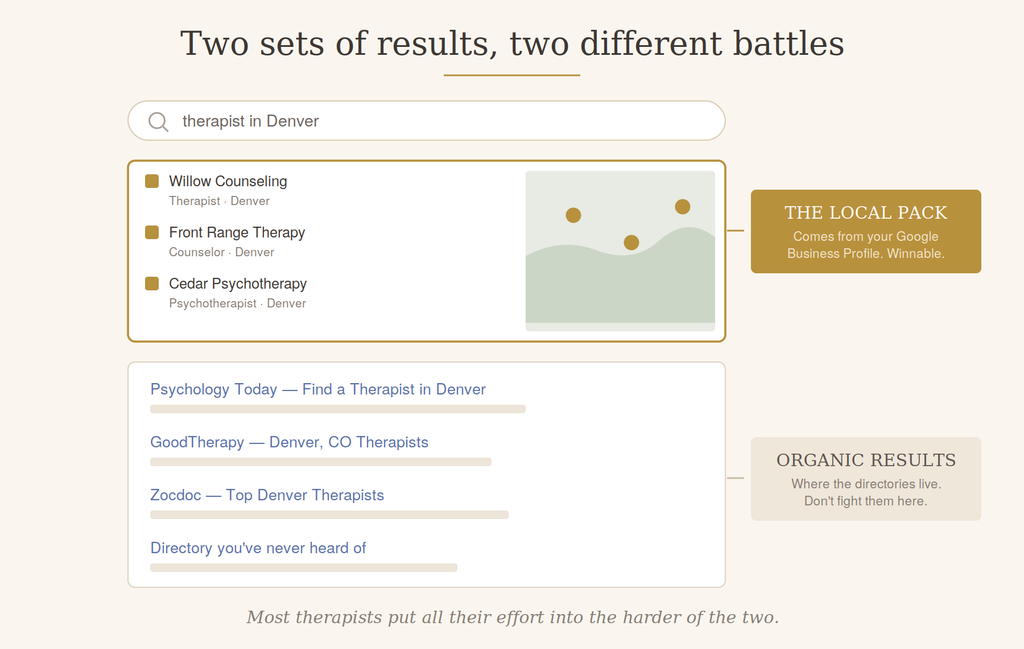
At the top, often with a map, there’s a small group of local businesses — typically three. That’s the local pack, and what appears there is drawn from Google Business Profiles, not from websites.
Underneath that are the ordinary results. That’s where the directories live.
This matters more than almost anything else I could tell you, because these two are won in completely different ways. You can rank beautifully in one and be invisible in the other. And most therapists put all their effort into the second one, which happens to be the harder of the two.
You are not going to outrank Psychology Today, and you don’t need to
I want to be straight with you about this, because I think a lot of people quietly blame themselves for something that was never winnable.
The directories — Psychology Today, GoodTherapy, Zocdoc, the health systems — have enormous authority, thousands of pages, and years of accumulated links. A single practice website is not going to beat them for “therapist in Chicago.” That’s not a failure of your website. That’s just the shape of the internet.
But here’s the thing. Directories mostly can’t appear in the local pack. That top map box is for actual local businesses, and you are one. So the space where the directories are unbeatable is the space you skip, and the space where you can genuinely win is sitting right above it.
And the long tail is yours too. Nobody’s directory listing is really competing for “EMDR therapist for first responders in Sacramento.” You can own that. The more specific you get, the more the advantage swings to you.
Your Google Business Profile is the whole ballgame
If you take nothing else from this: claim your profile at google.com/business and fill in every single field. Not most of them. All of them.
Google is trying to decide whether to show you to somebody. Every empty field is a question it can’t answer.
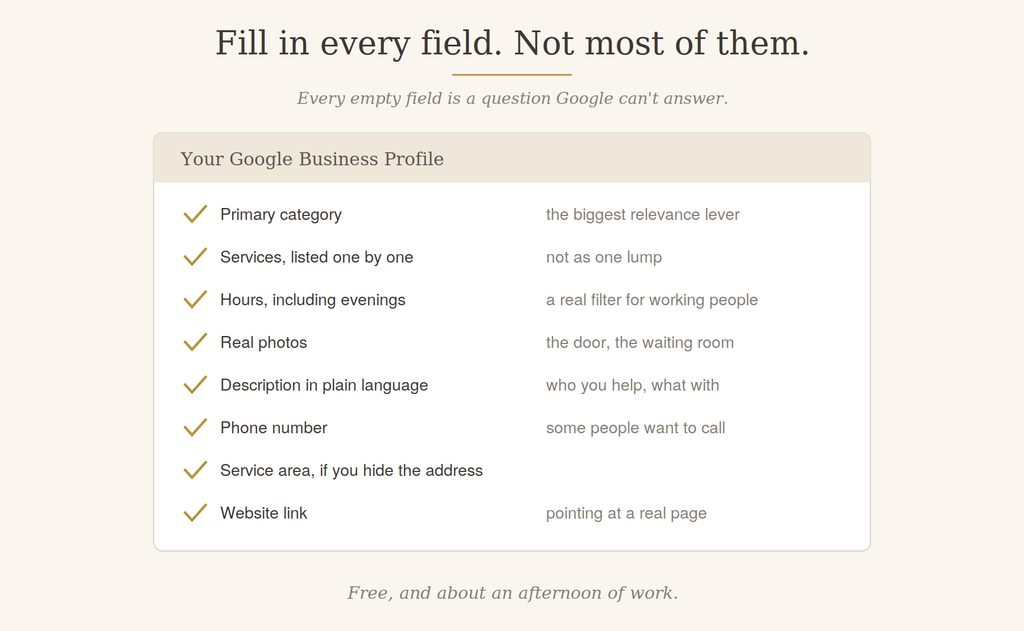
Fill in your services individually rather than as one lump — individual therapy, couples therapy, EMDR, whatever you actually offer, each as its own entry. Add your hours, including whether you have evening or weekend availability, because that’s a real filter for working people. Add photos: your office, your building entrance, the waiting area. Not stock photos. Someone anxious about a first appointment is genuinely reassured by knowing what the door looks like.
Write the description in plain language, the same way we’d write the top of your homepage — who you help and what you help with, in the words they’d use.
And then keep it alive. Profiles that get updated do better than profiles that sit still.
“But I don’t want my home address on the internet”
This is the question I get more than any other, and it stops a lot of people before they start. So let’s deal with it properly.
You do not have to display your home address. In fact, if you’re working from home, Google would rather you didn’t.
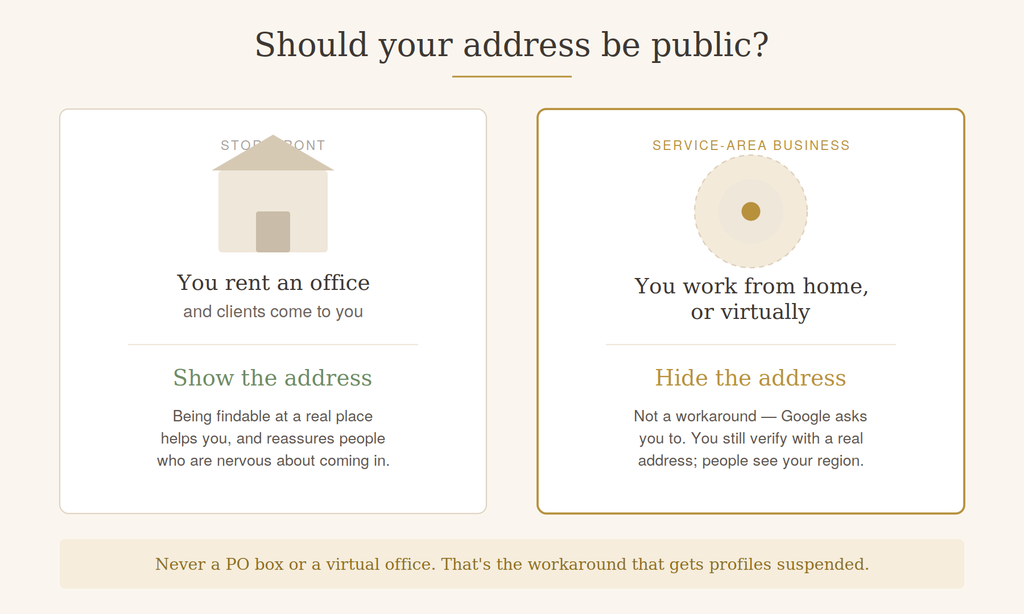
Google sorts businesses into two kinds. A storefront is somewhere customers come to you. A service-area business serves people without them visiting a base location. Service-area businesses hide the street address and show a service region instead — a set of cities, ZIP codes or areas you cover. Google is explicit that a business running from a residential address should clear that address from the profile, and profiles that leave a home address showing when they shouldn’t are a common reason for suspension.
So the answer for most of the therapists I work with is: set the profile up as a service-area business. You still enter a real address during setup, because Google needs somewhere to verify you, but it isn’t shown publicly. What people see is the area you serve.
Which one are you?
You rent an office and clients come to you. That’s a storefront. Show the address — you want it visible, because being findable at a real place helps you and reassures people. Don’t hide it just because hiding feels safer.
You work from home, virtually or otherwise. Service-area business. Verify with your real address, then switch off “show business address to customers,” and set the areas you actually serve.
You’re fully virtual. Same setup, and worth knowing this is the least clear-cut case — Google’s definition of a service-area business is built around businesses that travel to customers, and telehealth doesn’t quite fit that picture. It generally works in practice. Just don’t be surprised if verification asks more of you.
Two things not to do
Don’t use a PO box or a virtual office address. This is the workaround everyone thinks of and it’s the one that gets profiles suspended. Google requires a real address where your business genuinely operates.
Don’t claim thirty service areas. Google allows up to twenty, but a huge radius doesn’t make you rank further away — it just makes your profile look less specific about anywhere. List the places you’d actually take a client from.
The honest trade-off
Hiding your address can cost you some visibility, particularly if it was showing before. Testing by local search specialists has found meaningful ranking drops for businesses that removed an address that had been public for a while.
I’m telling you that because I’d rather you knew. But for almost everyone I work with it’s not really a choice — if you don’t see clients at that address, showing it isn’t an option Google offers you. So we take the trade-off and we make up the difference on the website, which is the next section.
Location pages: where the website does the work
Here’s how the two halves fit together. The profile gets you into the map for the area around you. The website is how you reach everywhere else.
This is the part most practices skip. If you see clients virtually, you’re licensed by state — which means you can legitimately serve anyone in that state, not just people near your office. So we build a page for each place you genuinely want to work in, and each page is about a real service you really offer, in a real place.
Not “therapist in Denver.” Something specific: virtual couples therapy in Denver. Online anxiety therapy for teens in Boulder. Whatever combination of service and place is true for you.
That works for three reasons. It’s far less contested than the head term, because most practices are still thinking one town at a time. It matches how people actually search once they know what they want. And it gives you somewhere to send people that speaks to their situation rather than a generic services page.
If you’re licensed in more than one state, that’s a page each. This is usually the largest untapped opportunity in a virtual practice.
One caution: these have to be real pages. A page that’s the same text with the city name swapped is thin, and Google is good at spotting it. Each one should say something true about working with people in that place.
Your category is the setting people get wrong
Google asks you to choose a primary category, and that one choice does a lot of work — it’s a large part of how Google decides which searches you’re relevant to.
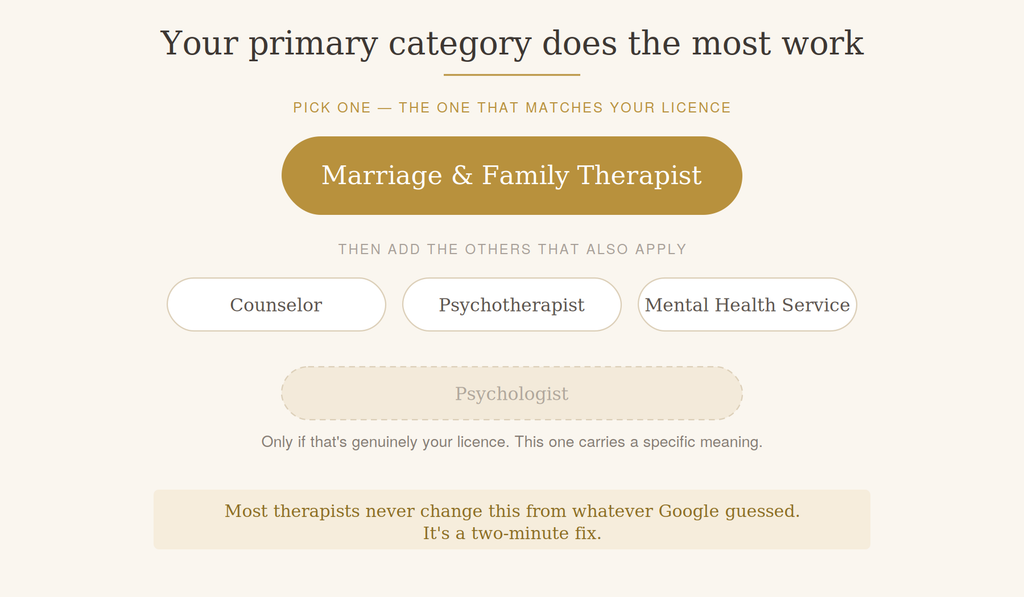
The options include things like psychologist, mental health service, counselor, marriage or family therapist, and psychotherapist. They are not interchangeable. “Psychologist” carries a specific meaning about your licensure, and choosing it when it isn’t accurate is a problem well beyond search.
So pick the one that genuinely describes your license and your work, and then add the others that also apply as secondary categories. The primary one is the one that matters most.
It’s a two-minute decision that people leave on whatever Google guessed for them.
Reviews: the problem, and three ways around it
Here’s where most local SEO advice falls apart for therapists.
Every guide you’ll read says the same thing: get reviews, ask every customer, make it easy for them. And for a plumber or a restaurant, that’s fine advice.
For you it’s a minefield. A client leaving a public review has disclosed that they’re in therapy, permanently, somewhere their employer and their family can see. Asking them to do it puts them in an awkward position with someone who has real influence in their life. And depending on your license and your board, soliciting testimonials from current clients may be off the table entirely.
I want to be clear that I’m a web designer and not an authority on the ethics here — where those lines sit is your professional judgement and your board’s, not mine. What I can tell you is what has actually worked for the therapists I build websites for.
And it turns out there’s a way through this that most people miss, which is that the most useful reviewers aren’t your clients at all.
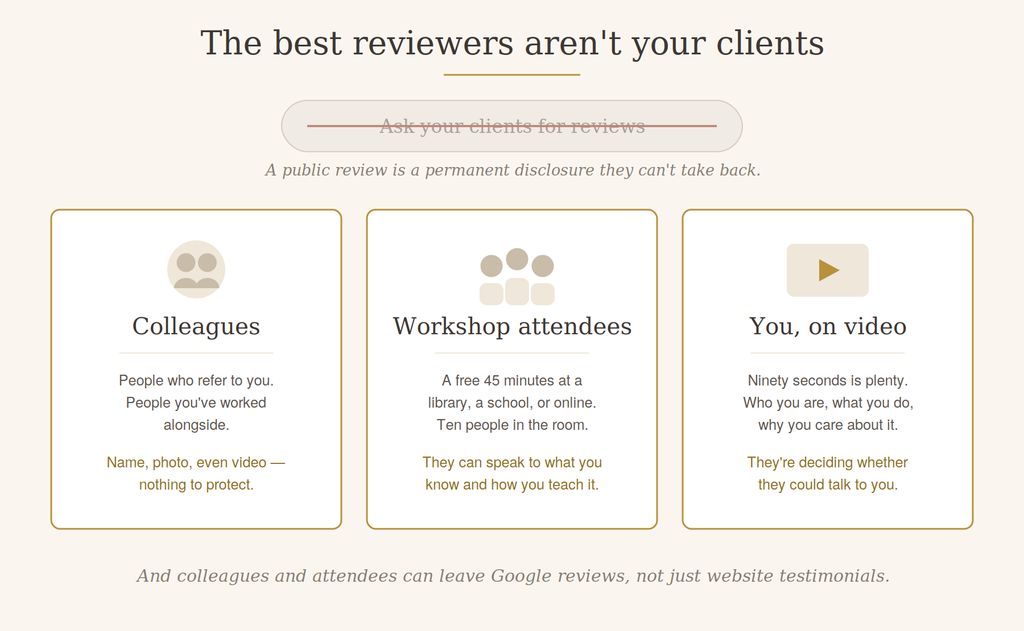
1. Colleagues
Other professionals — in mental health or in a related field, people who refer to you, people you’ve worked alongside in other settings — can speak about you publicly with none of the complications.
And they’re powerful precisely because they’re experts. When another clinician says you’re excellent and that you have a real impact on the people you work with, that carries weight a client review can’t, because they know what good work looks like.
Because there’s no confidentiality issue, you can use their name, their photo, even video — which is the strongest form a testimonial takes.
This is also worth doing as a two-way thing. Write one for a colleague, ask them for one, and you’ve built a professional relationship as well as a testimonial. Referrals tend to follow relationships.
2. Workshop attendees
If you run workshops — for parents, for couples, whatever fits your work — the people who attend are not your clients, and they can review you freely.
If you don’t run workshops, this is easier to start than it sounds. A free thirty or forty-five minute session at a library, a school, or online. Get ten people in the room, get reviews from half of them, and you’re already further along than most therapists will ever be.
And these reviews say useful things. Attendees can talk about how knowledgeable you are, how obviously you care about the subject, and how what you told them changed something in their life. That’s exactly what a prospective client wants to know, from someone with no confidentiality to protect.
3. A short video of yourself
This one’s different, because usually social proof means other people talking about you. But a very short video of you talking directly to a prospective client does a lot of the same work.
I know that’s an intimidating suggestion, and I understand the hesitation completely. But it doesn’t need to be polished or long. Ninety seconds is plenty. Introduce yourself, say what you do, say why you care about it.
What it gives someone is your voice and your face and a sense of what you’re actually like — which is what they’re really trying to work out. The goal was never to prove you’re qualified. It’s to let someone think, yes, I could talk to this person.
How this connects back to Google
Colleagues and workshop attendees can leave reviews on your Google Business Profile, not just testimonials on your website. That matters, because reviews are one of the stronger signals in local search and it’s the one most therapists assume is closed to them.
One honest caveat: Google asks that reviews reflect genuine experience of a business. A colleague who’s referred to you for years, or someone who sat through a workshop you ran, has genuine experience of your work. Someone who’s never encountered you doesn’t. Keep it real and you’re fine.
I’ve made a whole video walking through these three approaches in more detail — you can watch it here: https://youtu.be/VT_LOH_FIc8
Proximity, relevance, and prominence
Local rankings come down to roughly three things, and it helps to know which ones you can do something about.
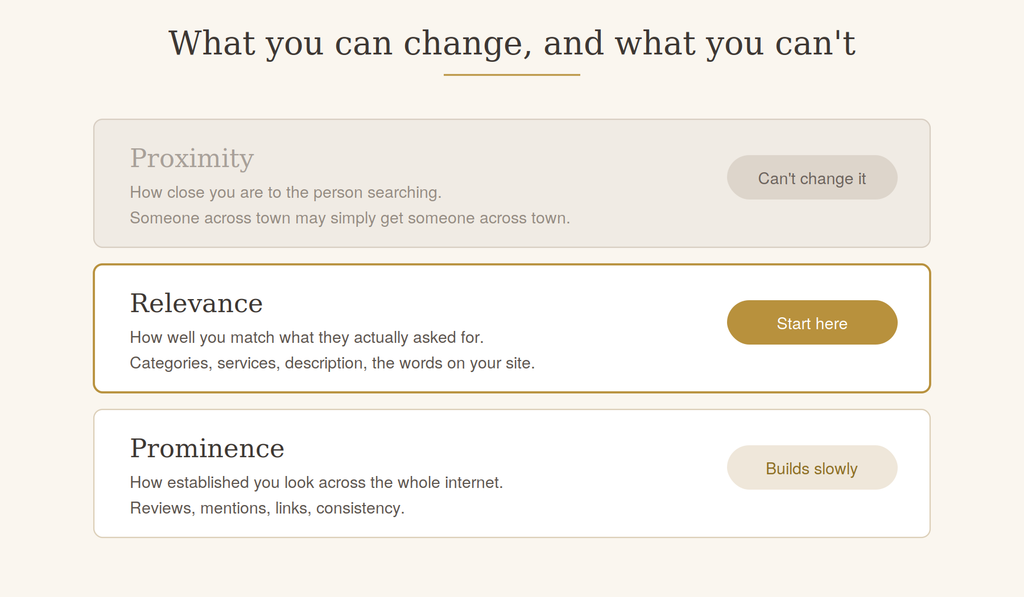
Proximity is how close you are to the person searching. You can’t change this. Someone across town searching “therapist near me” may simply get someone across town. That’s not a failure on your part, and it’s worth knowing so you don’t chase it.
Relevance is how well you match what they asked for. You have enormous control here — categories, services, description, the words on your site. This is where the work pays off.
Prominence is how established you appear across the whole internet: reviews, mentions, links, consistency. Slower to build, but it compounds — and the reviews section above is a large part of it.
So when someone tells you they searched and didn’t see you, the first question isn’t “what’s wrong with my website.” It’s “where were they standing.” Local results are personalized by location, which is also why checking your own rankings from your own office gives you a flattering and useless answer.
The rest of the website
Beyond location pages, a few things support the profile and are quick to get right.
Make sure your name, address and phone number are identical to what’s on your profile. Same abbreviations, same formatting. Google cross-checks these, and “Suite 200” in one place and “Ste. 200” in another is a small inconsistency that does no good.
Have a real page for each service, not one page listing everything. A page about your couples work can talk about your approach and what people come in with. One combined services page can’t do that with any depth.
Put your phone number somewhere obvious on every page. Some people want to call.
How long this takes
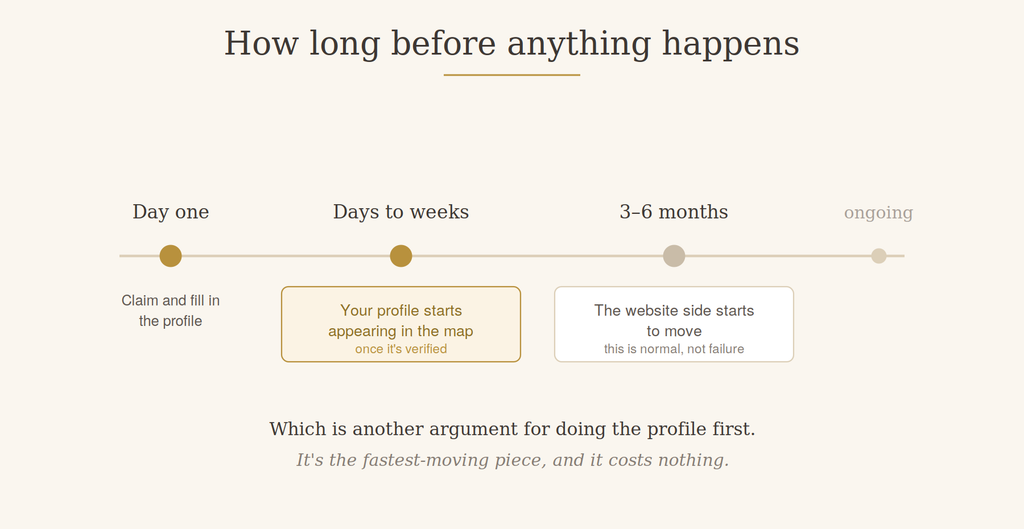
Your profile can start showing up within days to a few weeks once it’s verified and complete.
The website side is slower. Three to six months before you’d really judge it, and that’s normal rather than a sign it isn’t working.
Which is another argument for doing the profile first. It’s the fastest-moving piece and it costs nothing.
If you change one thing, change this
Claim your Google Business Profile and fill in every field, especially your primary category and your individual services. If you work from home, set it up as a service-area business so your address stays private.
Free, one afternoon, and it’s the difference between being eligible for the map results and being invisible in them.
Related reading:
What this is really about
None of this is about beating an algorithm.
Somebody in your town is sitting up at two in the morning typing something into their phone, trying to find out whether there’s anyone nearby who could help. If you’re not there, they don’t find nothing — they find a directory, and a list, and they pick someone at random, or they close the phone and don’t try again for another six months.
Being findable is part of being available. It’s not marketing in the way that word usually gets used, and it isn’t persuasion. It’s making sure that the people who need what you already know how to do can actually reach you.
If you’d like help with any of this, that’s what I do — I build websites for therapists in private practice and help them get found. My inbox is open.