

Let’s say someone has been white-knuckling their way through a hard few months, and tonight they finally pick up their phone and type “therapist near me.” Google shows them a map with three practices at the top and a list of websites underneath. Most people will call one of the three on the map. Many never scroll any further.
If you’re not one of those three, it’s not that you’re not a good therapist. It’s that Google doesn’t have enough clear information to know you’re the right match for that person, in that place, at that moment. And the hopeful part is that local SEO is mostly about giving Google clear, accurate, consistent information. It’s not a trick, and you don’t need to be a technical person to do it.
This guide walks through everything that matters for therapists, in the order I’d do it. Where something is commonly recommended but doesn’t actually hold up, I’ll tell you, so you don’t spend your limited time on it. If you’d like the bigger picture of how local SEO fits with the rest of your online presence, our complete SEO guide for therapists is the place to start.

What local SEO is (and what it isn’t)
Regular SEO is about showing up when someone searches for a topic, like “how to cope with panic attacks.” Local SEO is about showing up when someone searches for help in a place, like “anxiety therapist in Bethesda” or just “couples counselor near me.”
Those searches show results in two places. First is the map pack, the three listings with the map at the top. Those come from your Google Business Profile. Second are the regular website results underneath, which come from your website. You want to show up in both, and they need each other, so you’ll work on both in this guide.
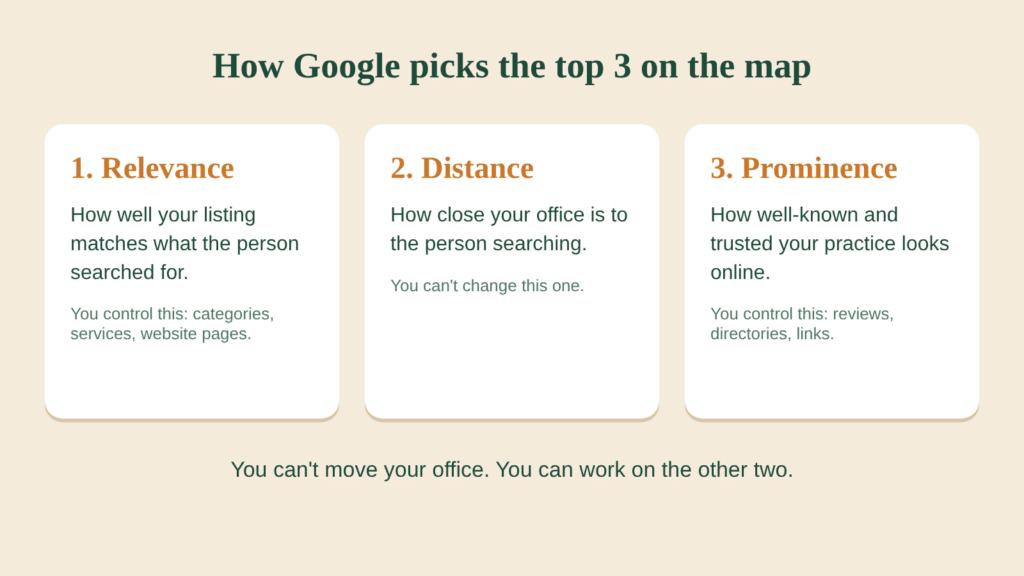
Google has said that it decides who shows up in local results mostly based on three things: relevance (how well your listing matches what the person searched), distance (how close you are to them), and prominence (how well-known and trusted your practice looks online). You can’t change where you are, but you have real control over the other two.
Is local SEO right for your practice?
Local SEO works for practices where clients come to you in person, or where you’re licensed to serve a specific area. If you see clients in an office, it’s the most important kind of SEO you can do.
If you only see clients by telehealth, it’s a little different. Google’s rules for Business Profiles expect a business to have in-person contact with customers during its stated hours, which means a purely virtual practice usually can’t get a map listing (you can read their guidelines for the details). If that’s you, don’t worry. Your website, your directory profiles, and the content on your site carry the load, and the “your website” part of this guide still applies to you. You’d write about the states you’re licensed in instead of a neighborhood.
Step 1: Set up and fill out your Google Business Profile
Your Google Business Profile is the listing that appears on the map, and it’s free. For most therapists it’s the single biggest piece of local SEO, so it’s where I’d begin. If you’ve never claimed yours, search your practice name on Google, and look for a “Claim this business” option. If you can’t find one, you can create it at business.google.com.
Pick your categories carefully
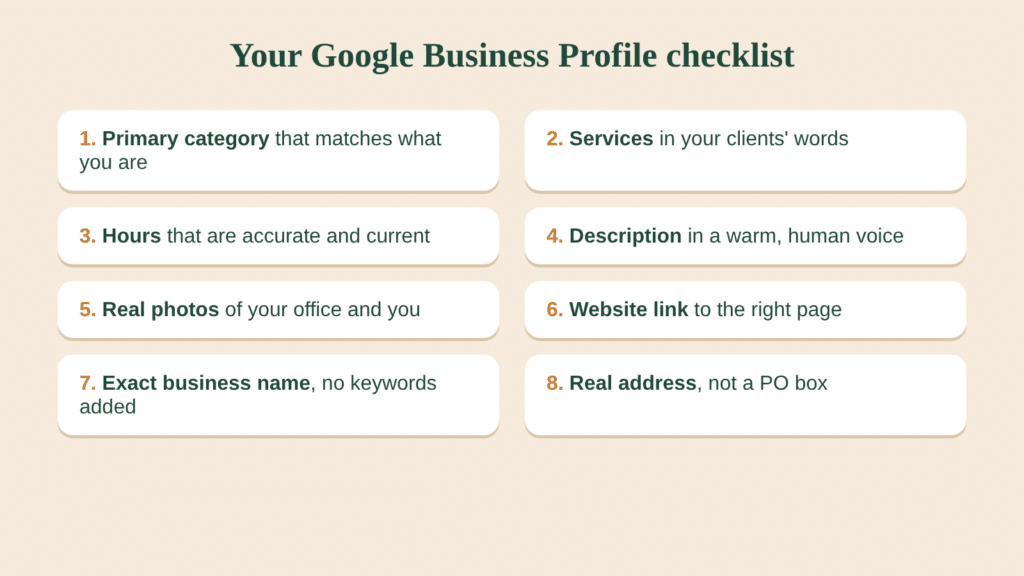
Your primary category is the single most important setting on your profile. Whitespark, which runs an annual survey of local search experts, ranks it as the number one factor in map results, year after year.
Choose the category that describes what you are, not what you offer. If you’re a licensed psychologist, choose Psychologist. If you’re a licensed counselor or therapist, you’ll typically see options like Psychotherapist, Counselor, or Marriage and Family Therapist in the dropdown. Look at the exact wording Google offers, because it changes from time to time. Then add a few secondary categories if they’re true, up to nine, but Google recommends using as few as will describe you accurately. More isn’t better here.
Fill in your services
This is one that a lot of therapists skip, and it’s worth doing. The Services section of your profile has real testing behind it: Sterling Sky, a respected local SEO firm, ran a controlled test and found that adding services improved rankings within a few days.
List the things you actually do, in the words your clients would use. Anxiety therapy, EMDR, couples counseling, therapy for teens, trauma therapy. Add a short plain-language description for each one that sounds like you talking to a person, not like a clinical brochure.
Everything else on your profile
- Hours. Whitespark’s survey also finds that being open at the moment someone searches is one of the top factors. Keep your hours accurate, and if you take calls or sessions at specific times, set them to match.
- Business description. You get 750 characters. Say who you help, what you help with, and where you are, in a warm, human voice. Skip the keyword lists. They don’t help, and they can read as spammy.
- Photos. Use real photos of your office, your waiting area, and a headshot. Google’s own data says that profiles with photos get more requests for directions, and honestly it also helps the person feel like they know where they’re walking into. Skip stock photos.
- Website link and booking link. Link to your homepage, or to a page about the specific service where it makes sense.
- Business name. Use your real practice name exactly as it appears on your door and your website. Adding “Anxiety Therapist Bethesda” to the end of it might seem clever, but it breaks Google’s rules and can get your profile suspended.
What about posting on your profile?
You’ll see lots of advice to post weekly. It’s fine to post if you enjoy it, but the evidence says it doesn’t move your ranking. Sterling Sky tested this over nine weeks across several listings and found no measurable effect, and Whitespark’s survey agrees. If your time is limited, put it into your reviews and your website instead.
If you work from home
Many therapists see clients from a home office or a shared suite. If clients don’t come to your home, you can set your profile up as a service area business and hide your address. If clients do visit, you’ll want to think carefully about how much privacy you’re comfortable with, because a visible address is part of what Google uses to confirm you’re real. Don’t use a PO box or a virtual office address. Google doesn’t allow them, and a profile that breaks that rule can be suspended.
Step 2: Keep your information the same everywhere
Your practice name, address, and phone number (people in SEO call this your NAP) should be written exactly the same way everywhere you appear online: your website, your Google profile, Psychology Today, and any other directory you’re listed in.
I’ll be honest about how much this matters. A lot of articles claim it’s a huge ranking factor, and it’s not. BrightLocal’s research puts citations at a much smaller share of map rankings than your profile itself or your reviews. But it’s still worth doing for two reasons. It’s easy, and it helps both Google and AI tools confirm that your practice is real, and where it is. And if the phone number on an old directory is wrong, a person who finds you there can’t reach you.
Here’s how to do it quickly:
- Write down the exact version of your practice name, address, suite number, and phone number that you want to use everywhere. Keep it in one document.
- Search your practice name and your own phone number on Google, and open the first couple of pages of results.
- Fix anything that doesn’t match, especially old addresses from before a move, and old phone numbers.
- Claim and fill out your profiles on the directories that matter for therapists: Psychology Today, GoodTherapy, TherapyDen, and Open Path Collective if it applies to you, plus your state or local professional association.
Choose a few good directories rather than signing up for dozens. Psychology Today in particular sends real inquiries on its own, in addition to what it does for your search visibility.
Step 3: Make your website say where you are and who you help
Google reads your website to understand your practice, and so do the people who land on it. Both of them need to find the same answer quickly: what you do, who you do it for, and where.

Start with your key pages
- Your homepage. Say your city or area and your main specialties in the first lines of text, in plain words, like “I help adults in Silver Spring and the surrounding area who are dealing with anxiety, burnout, and big life changes.”
- One page for each service. Instead of one page that lists everything, give each main service (anxiety therapy, couples counseling, EMDR) its own page, with your location mentioned naturally. This is where people searching for a specific kind of help will land, and it’s also what gives Google something specific to match.
- Your contact page. Include your full address, phone number, hours, a map, and a short note about parking or how to find you. Make sure these match your Google profile exactly.
- Your page titles. These are the blue links people see in search. Each one should name the service and the place, like “Anxiety Therapy in Silver Spring, MD | Your Practice Name.”
A note on separate pages for every town
You’ll see advice to make a separate page for every neighborhood or town you could serve. Unless you actually have an office in each place, I’d skip it. Pages that are nearly identical with only the town name swapped out don’t help you, and they can make a site look thin. One strong page per service, written for the people you actually see, will do more for you.
Let your website do the quieter work, too
- Make it work well on a phone. Most “near me” searches happen on a phone. If your site is slow, or your phone number isn’t tappable, you’ll lose people who were ready to call.
- Answer the questions people are really asking. A short FAQ on your service pages about cost, insurance or private pay, what the first session is like, and whether you offer telehealth gives Google useful information, and it helps nervous people take the next step.
- Add structured data. This is a bit of behind-the-scenes code that tells Google your practice’s name, address, hours, and what kind of business you are. If your site was built by a designer, it’s worth asking whether it’s included. If you’d like help with it, our SEO service covers it.
Step 4: Reviews, with care
Reviews matter in two ways. They’re one of the things Google looks at when it decides who goes in the top three, and they help people decide whether to call. According to BrightLocal’s 2024 survey, 88% of consumers said they’d use a business that responds to all of its reviews, compared with 47% for one that never responds.
Therapists have to be more careful than most businesses, though, for three reasons.
Asking for reviews
Many licensing boards and professional ethics codes discourage or restrict asking current or former clients for reviews or testimonials, because of the power difference in the relationship and the privacy concerns. Check what your own board and code of ethics say before you ask anyone. If you’re not allowed to ask, you can still make it easy for people who want to leave one on their own by having your Google profile easy to find, and you can ask colleagues, supervisors, or people who’ve worked with you in a non-clinical role, like a workshop you led, if that’s allowed in your field.
Whatever you do, never offer anything in exchange for a review, and never ask only for positive ones. The Federal Trade Commission now bans paying for reviews in a way that depends on what they say, and Google can remove reviews or add a warning label to a profile for fake engagement.
Replying to reviews
This is the one that catches therapists out. Even a kind reply to a glowing review can confirm that the person was your client, and that’s protected health information. The federal government has fined healthcare providers for exactly this, including a $50,000 penalty against a dental practice that described a specific patient’s visit in a reply.
The safe approach is a short, general reply that never confirms or denies that someone is a client and never repeats any detail from the review. For example:
“Thank you for taking the time to share your feedback. I’m not able to confirm or discuss anyone’s care, but I appreciate you reaching out, and I wish you well.”
You can use the same reply for negative reviews, and add a line inviting the person to contact you directly if they’d like to talk it through. And if you’re ever unsure, it’s okay not to reply at all.
Step 5: Build trust beyond your own pages
Google also looks at how the rest of the internet talks about you. For a local practice, you can build that in simple, human ways:
- Your local chamber of commerce or business association. Many have a member directory with a link to your website, and they’re a respected source in your area.
- Your professional associations. State and local counseling, psychology, social work, and marriage and family therapy associations often list members on their sites.
- Community connections. Schools, community centers, faith communities, and local nonprofits you work with might be glad to link to you as a resource. A quick note that offers something useful, like a talk or a handout, goes further than a request for a link.
- Local media and podcasts. Local news and community newsletters often look for a mental health expert to quote. Being the person who answers is a great way to earn a link from a trusted site.
Step 6: Write about the things your clients are searching
A page or post that answers a real question your clients ask is one of the best ways to appear for searches beyond “therapist near me.” Think about what someone would type before they’re ready to book: “how do I know if I need couples counseling,” “what happens in a first therapy session,” “is it normal to feel anxious after having a baby.”
Write those in your own warm voice, mention your location where it fits naturally, and link them to the relevant service page so a reader knows how to take the next step. You don’t need to write a lot. One good post a month is plenty, and a post that really helps someone will outperform several that don’t.
If you work with private pay or insurance clients
The words people search with are different. People looking for out-of-network or private pay therapists tend to search things like “therapist who doesn’t take insurance” or “specialist for [specific issue],” while people using insurance often search with the name of their plan. Say plainly on your site which one you are, so that the right people find you, and the wrong ones don’t waste a call.
How to tell whether it’s working
Local SEO takes patience, and you can see progress sooner than you’d think if you know where to look.
- Your Google Business Profile. Search your practice name and look at the performance numbers Google shows you: how many people called, asked for directions, or clicked through to your website.
- Google Search Console. This free tool shows which searches your website appears for, and how many people click. If you see lots of impressions and few clicks, your page titles probably need work.
- A manual check. Open a private browser window and search “therapist near me” and your main specialties, ideally from near your office. You’re looking at whether you’ve moved up from where you started. Some tools show this on a grid map, but a simple look is a good place to begin.
- Your inquiries. Ask every new client how they found you, and keep a simple list. This is the number that matters most.
As a general guide, expect to see changes in your profile within a few weeks and in your website over a few months. Anyone who promises to get you into the top three quickly doesn’t understand how this works.
Common mistakes to avoid
- Choosing the wrong primary category. It’s the biggest single setting, so choose it thoughtfully.
- Leaving the profile half-empty. A complete profile tells Google, and the person looking at it, that you’re real and open.
- Stuffing keywords into your business name. It can get your profile suspended.
- Using a PO box or virtual office address. Same problem.
- Letting old information stay online. An old address or phone number sends people to the wrong place.
- Copying your own page for every town. Thin, repeated pages do more harm than good.
- Replying to a review in a way that confirms someone was a client. Keep every reply general.
- Making lots of changes to your profile in a short time. Big bursts of edits are one of the common triggers for a suspension, so make changes calmly, a few at a time.
A 30-day plan you can follow
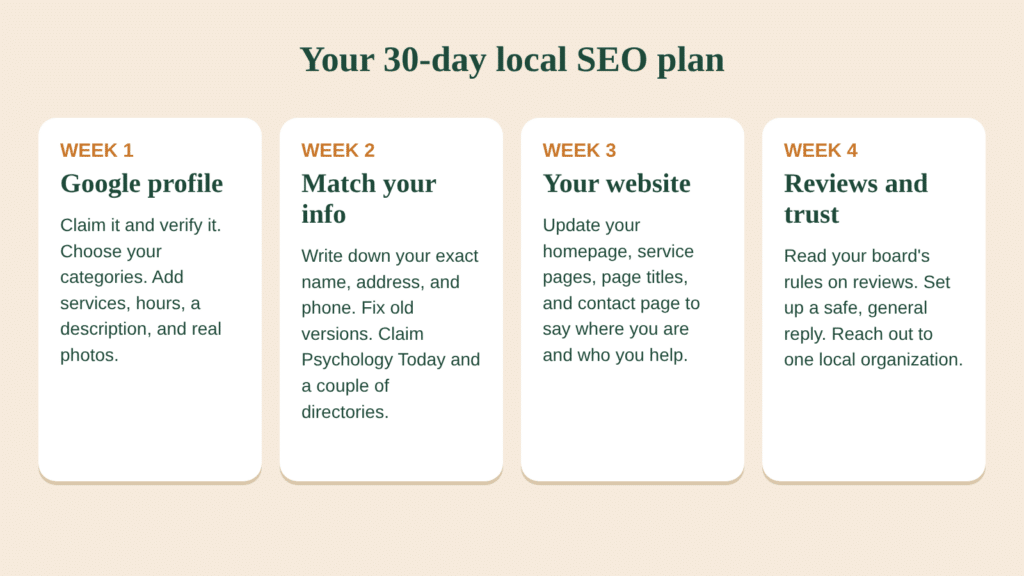
Week 1: Your Google Business Profile. Claim it, verify it, choose your categories, fill in your services, hours, description, and photos.
Week 2: Make your information match. Write down your exact name, address, and phone number, search for old versions, and fix them. Claim your profiles on Psychology Today and one or two other directories.
Week 3: Your website. Update your homepage, your main service pages, your page titles, and your contact page so each says where you are and who you help.
Week 4: Reviews and trust. Read your licensing board’s rules on reviews, set up a general reply you’re comfortable using, and reach out to one local organization or association about listing your practice.
Frequently asked questions
How long does local SEO take to work?
You can often see movement on your Google profile within a few weeks, and your website usually takes a few months. It depends on how many other practices are nearby and how complete your profile was to begin with.
Do I need a physical office to show up on the map?
Google expects in-person contact with customers for a Business Profile, so a practice that is fully virtual usually can’t have one. A strong website and directory profiles are your best route in that case.
How many reviews do I need?
There’s no magic number. A steady trickle of genuine reviews is better than a burst, and many therapists do well with a small number. What matters most is following your board’s rules about asking for them.
Do I have to post on my Google profile every week?
No. Tests show it doesn’t change your ranking. Put your effort into the parts of the profile that do.
Is it worth hiring someone to do this?
If you have the time, you can do most of this yourself. The parts that people most often ask for help with are the website pages and the behind-the-scenes code, and keeping an eye on things month after month.
If you change one thing this week
Claim your Google Business Profile and fill in every part of it, starting with your primary category and your services. It’s free, it takes about an hour, and it’s the thing most likely to move you toward that map at the top.
Want help with this?
If you’d rather have someone handle the setup and keep an eye on it for you, that’s what our SEO service for therapists is for. And if you’d like to map out your own plan first, the free SEO Planning Worksheet (PDF) will walk you through it.